
15 Winter Lighting Ideas to Beat Dark Evenings in a Small Apartment

A small apartment in winter has one unfair problem: it gets dark at five, and the ceiling light — the single, flat, too-bright light most rentals come with — makes that darkness feel worse, not better. The fix is not more light. It is lower light, warmer light, in more places. Winter lighting works in layers, and a small room needs fewer layers than you think.
Every idea below is sized for renters in small rooms. Nothing is hardwired, nothing touches the ceiling wiring, and everything runs on a plug, a battery, a USB cable or a removable adhesive strip — so it all comes with you when you move.
Work in this order: one lamp at standing height, one at sitting height, one glow at floor or windowsill level — then add one thing that twinkles. Three or four of these ideas layered together will carry a small flat from November to February.
Start Here: Which Glow Does Your Flat Need First?
1. Start With Layers: One Tall Lamp Beside the Sofa
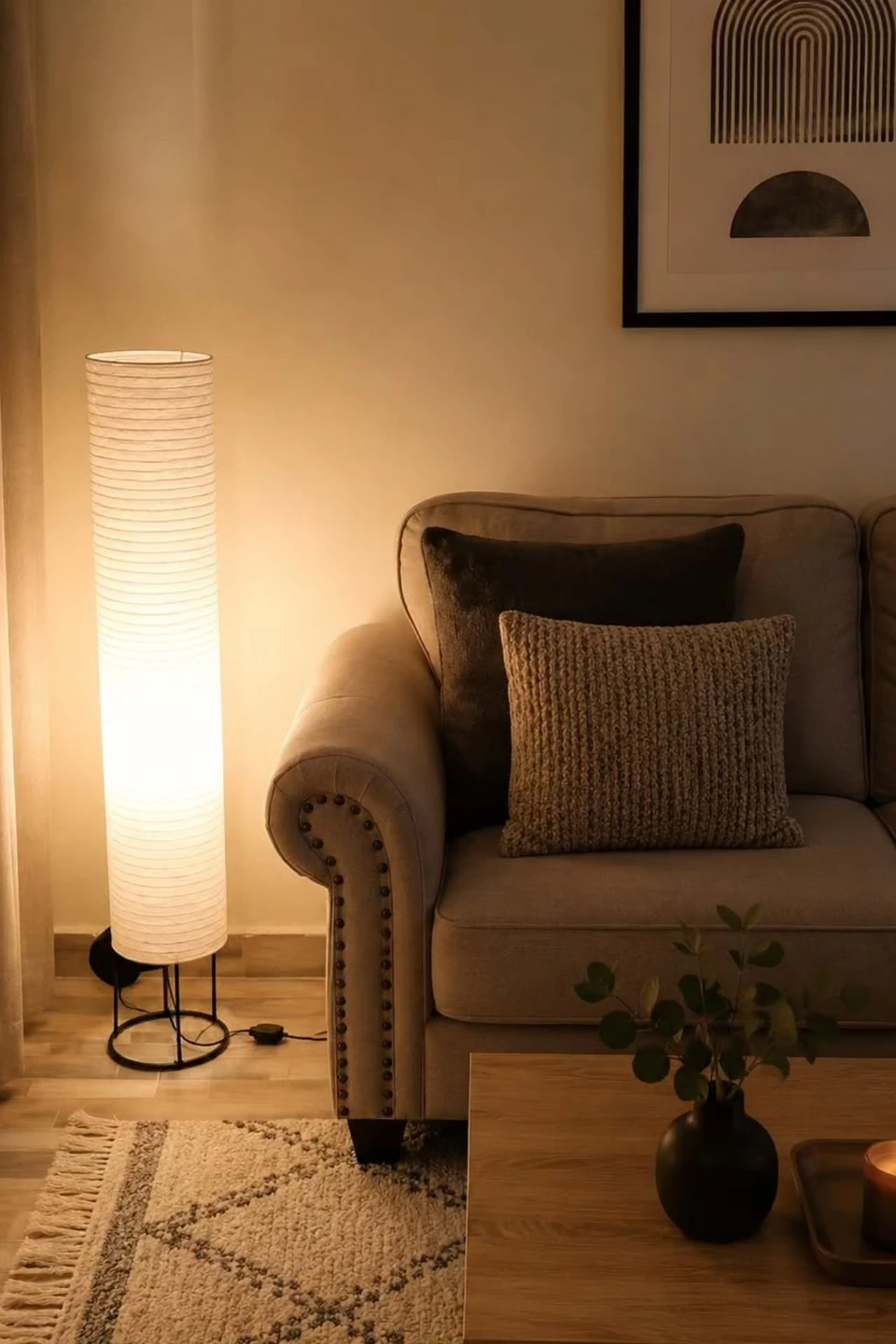
Image credit: @morty_lamps_ke — Instagram
Every cozy winter room you have ever saved has the same secret: the ceiling light is off. In its place, a tall lamp beside the sofa throws warm light at sitting height, exactly where faces, books and mugs are. A slim paper or fabric floor lamp does this for almost no floor space — its footprint is smaller than a shoe.
Put the lamp in the corner the sofa already points at, close enough that its light pools over the seat you actually use. Warm-white bulbs only: look for 2700K on the box. Anything cooler reads as office, and office is the feeling you are trying to undo.
This is layer one of three. On its own it already changes the room; with a low glow and something twinkling added later, the ceiling light becomes the one you use for cleaning and losing things — nothing else.
💡 Evening test: Sit where you always sit and turn only this lamp on. If you can read comfortably and the corners have gone soft, layer one is done.
2. Run Fairy Lights Around the Window Frame
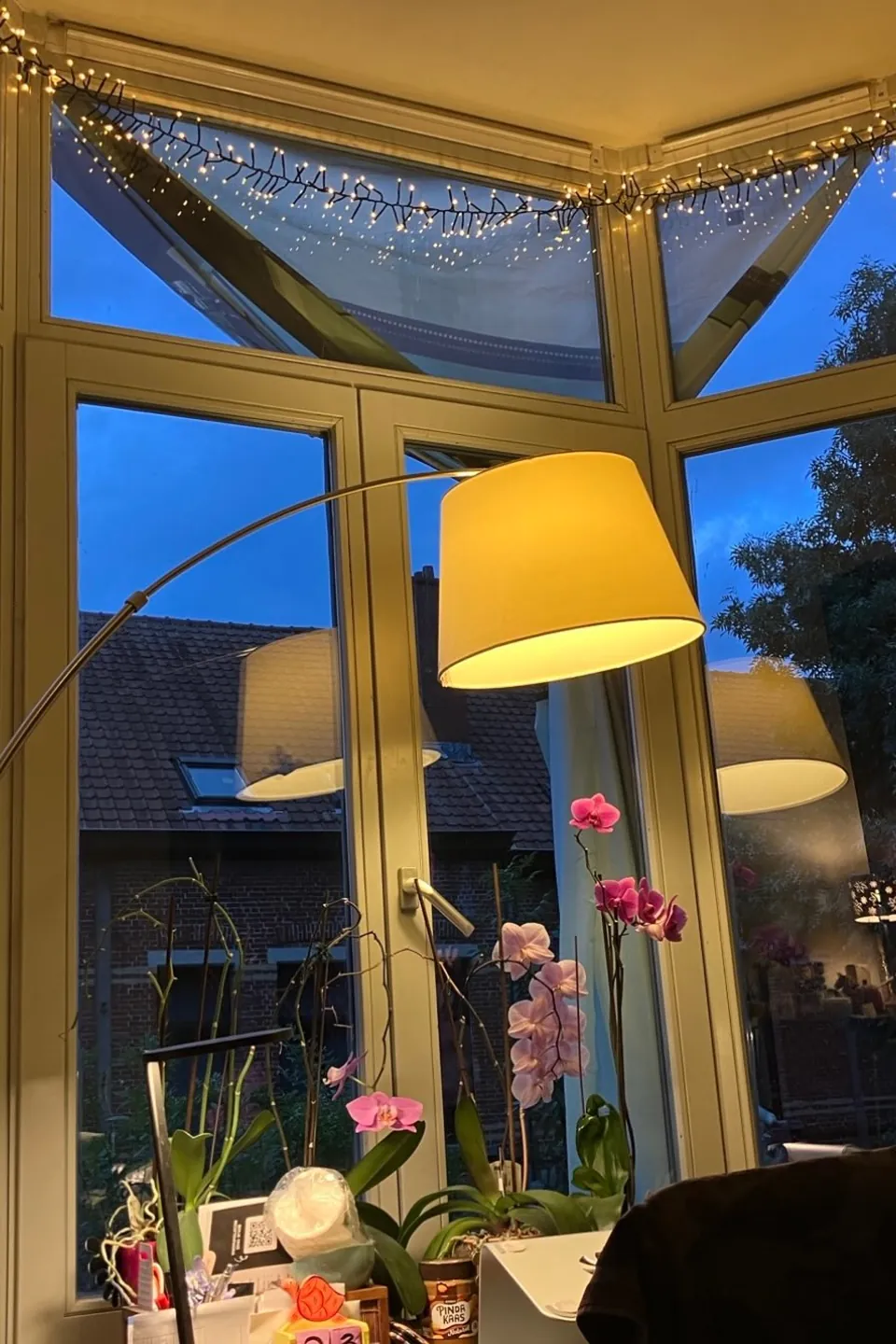
Image credit: @ninettemurk — Instagram
The window is the darkest rectangle in a winter room — a black mirror from five o’clock on. Outlining it with a string of warm fairy lights turns it back into a feature: the frame glows, the glass reflects a little of it, and the whole wall looks deliberately lit rather than accidentally dark.
Fix the string along the inside edge of the frame with clear removable clips or tiny adhesive hooks — never pins into the frame, never tape on paintwork. Battery strings with a timer are the renter’s friend: six hours on, eighteen off, and no cord trailing to the nearest socket.
Keep the drop simple. A single neat outline reads as architecture; three swagged loops read as a party. You are building the first one.
💡 Evening test: Look at the window from the street-side chair at dusk. The frame should read as a picture frame of light, not a outline of bulbs.
3. Hang One Big Paper Star in the Window

The Scandinavian paper star is the single hardest-working winter light there is. One star, hung in the window on its own cord, glows like a small warm moon — it lights the room softly, it reads as decoration from the street, and it costs less than a pizza.
Hang it from a removable hook on the frame or a swag hook on the ceiling with the cord run neatly down the wall to the socket; battery and USB versions exist if no socket is near. Choose the biggest star your window can take — on a small window, 45 to 60 cm fills the glass beautifully.
Keep the bulb warm and low-wattage. A paper star is a glow, not a floodlight, and its perforations throw the prettiest pattern when the bulb inside is gentle.
💡 Evening test: Check it from outside if you can. The star should look like a lantern in the window, not a bulb in a bag.
4. Go Tall With Taper Candles in Candelabras
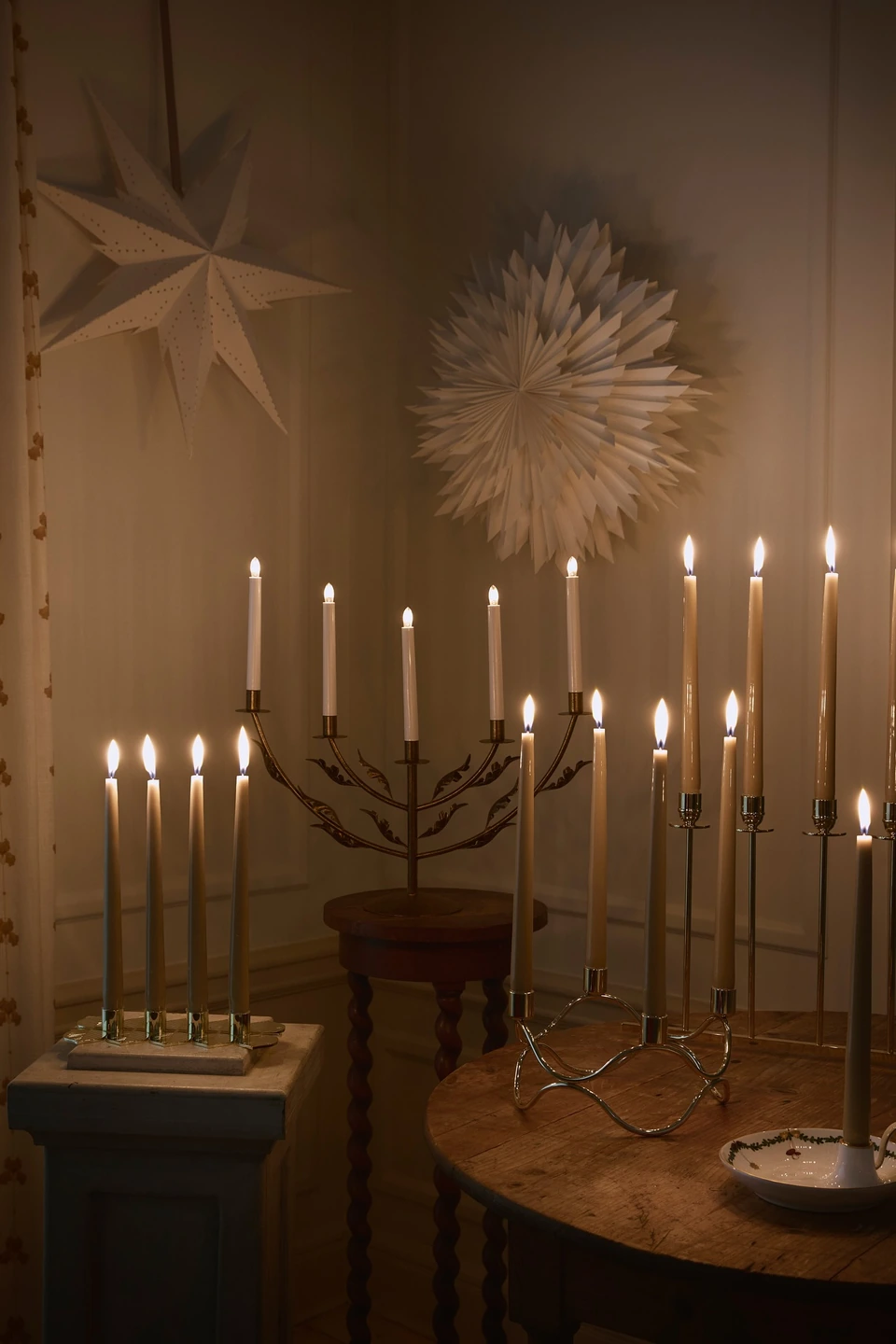
Image credit: @cervera — Instagram
Height is what candlelight usually lacks — tealights glow at ankle level and light nothing but the table. Tall tapers in standing candelabras lift the flame to picture height, where it lights faces, walls and the ceiling edge, and a cluster of them turns one corner of a small room into the warm end of it.
Group two or three holders of different heights on one surface — a side table, a mantel, the end of a counter — rather than scattering singles around the room. The cluster is the statement; the rest of the room can stay dark and calm around it.
Renter rules for real flame: holders on a tray or plate, tapers well away from curtains and paper stars, and never left burning in an empty room. LED tapers with a moving flame tip have become good enough that guests rarely notice — they are the worry-free version of this exact look.
💡 Evening test: The flames should sit just below standing eye level. If you are looking down on them, the holders are too short to light the room.
5. Build a Reading Corner Around One Small Lamp

Image credit: @spicysaltysweethome — Instagram
A reading corner does not need a spare room. It needs a chair turned slightly away from the television, a surface at elbow height, and one small lamp whose whole job is that chair. The lamp makes the corner a destination — the place the evening naturally ends up.
The modern renter’s version uses a cordless rechargeable lamp: no socket hunt, no cord across the floor, and it can sit on a tray on the ottoman, a stool or a stack of books — wherever the chair is. Charge it by day, and it gives four to eight hours of warm light by night.
Finish the corner with what your hands reach for: the current book, a coaster, a throw over the chair arm. If the corner holds those three things and a lamp, it is complete.
💡 Evening test: Read a full page. If you are squinting or the light is behind you casting your own shadow on the book, swing the lamp to your shoulder side.
6. Trail Fairy Lights Along the Ceiling Line of the Bedroom
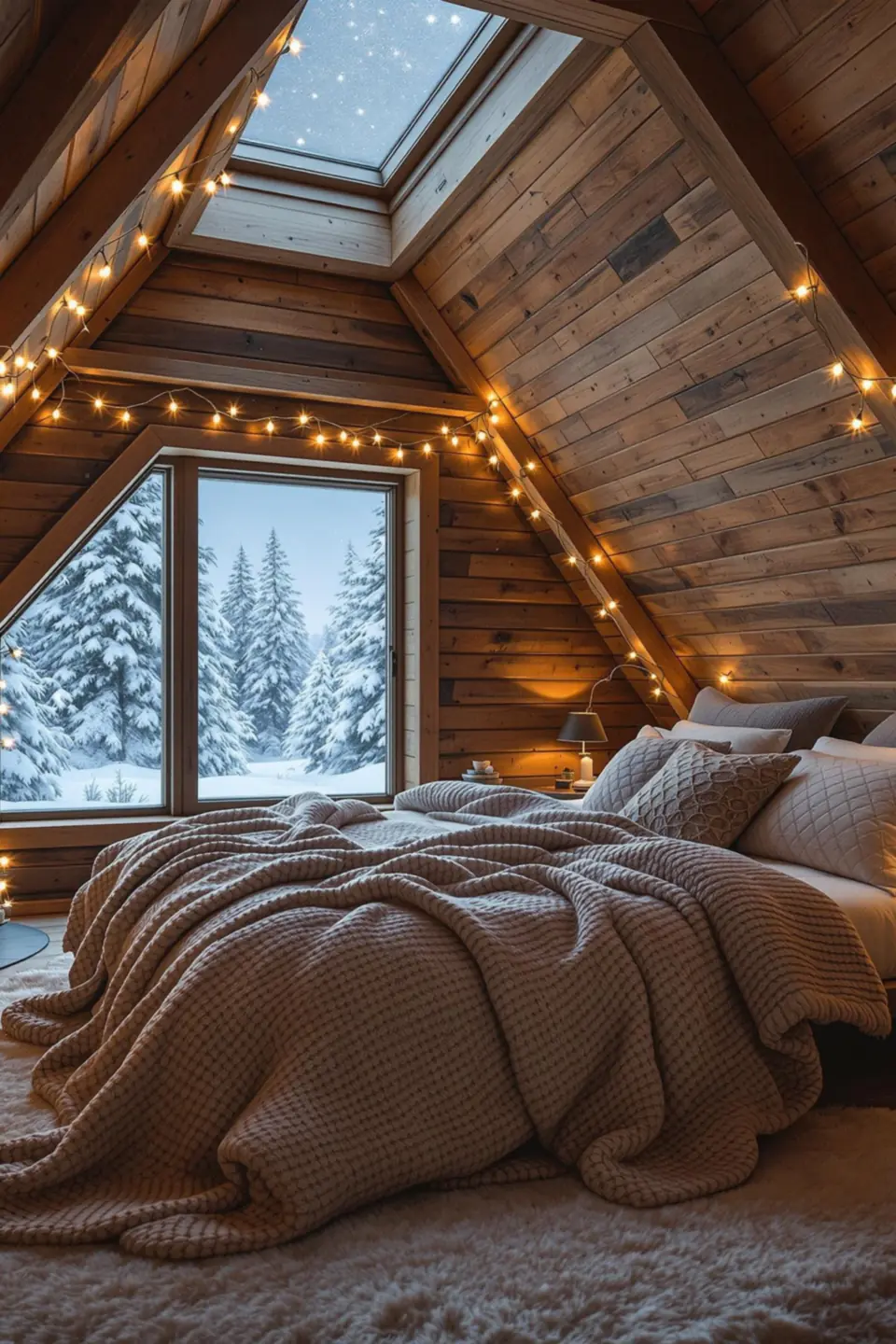
Image credit: @comfortineverycorner — Instagram
Bedrooms are where winter darkness does its worst work, and where overhead light feels most hostile. A string of warm fairy lights trailed along the ceiling line — the beams if you have them, a picture rail or the top of the wardrobe if you do not — replaces the big light with a soft canopy glow you can actually wind down under.
Fix with removable clips every half metre so the line stays even, and put the string on a timer to fade the room into evening at the same time each day. Warm white only, and choose the steady setting: bedrooms are for the slowest, calmest light you own.
This is also the cheapest room transformation on the list. One string, one evening, and the bedroom stops being the room the dark gets to first.
💡 Evening test: Lie in bed and look up. You want a glow you can see the room by, not individual bulbs glaring back at you.
7. Put a Daylight Lamp on the Desk for Dark Mornings

Not all winter lighting is about evening. A daylight therapy lamp on the desk — a slim panel that mimics bright morning light — is the winter tool for people who work from a small flat and do not see the sun on weekdays. Half an hour beside it at breakfast or over the first emails is the standard routine.
It earns its desk space by being small: most panels are the size of a tablet and stand where a photo frame would. Keep it at eye level, angled toward you, close enough to matter — about an arm’s length — and let the rest of the desk stay warm-lit and dim around it.
The contrast is the point of this one. The panel is deliberately bright and white against a cozy room, a little patch of June on the desk in the middle of January.
💡 Evening test: This one is a morning test — use it before noon. Bright light late at night works against the sleep the rest of this list is building.
8. Line Up a Candle Bridge on the Mantel or Windowsill

Image credit: @sostrenegrene — Instagram
The electric candle bridge — a row of seven taper bulbs in an arched wooden frame — is Scandinavia’s answer to the darkest month. It sits in the window or on the mantel, it is switched on in late November, and it glows every evening until spring. No flame, no wax, no watching it.
For renters it is close to perfect: nothing to fix, nothing to drip, and the flat row of lights reads from across the room like a line of real candles that never burn down. Modern versions run on batteries or USB with timers built in.
Dress its base simply — a bow, a sprig of greenery, nothing that touches the bulbs — and let it be the one light that is always on when you come home.
💡 Evening test: Put it on the timer once and judge it for a week. The bridge earns its place on the evenings you forget it is there.
9. Hang a Curtain of Lights Behind Sheer Curtains
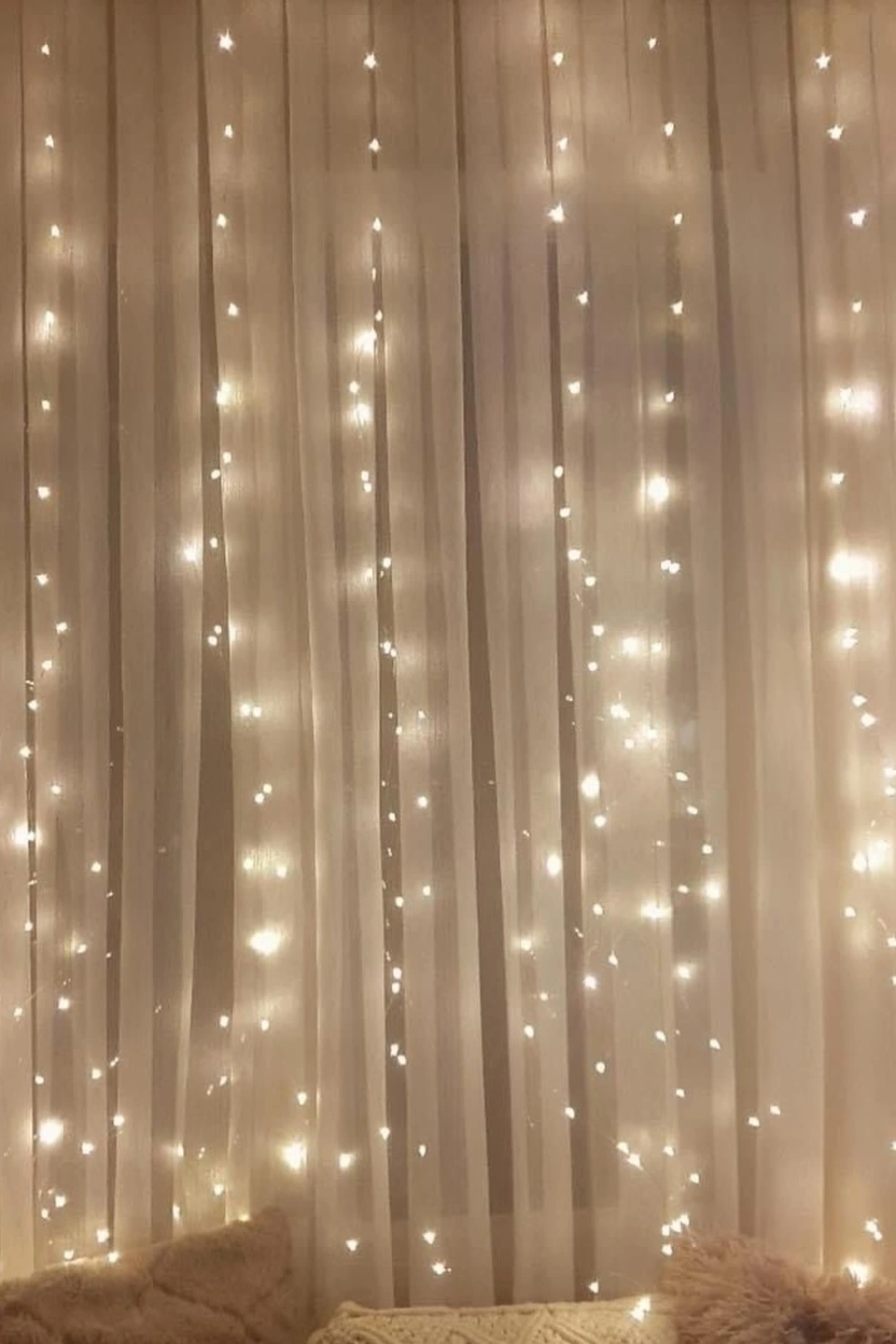
Image credit: @parinakonwarr_ — Instagram
A string-light curtain hung behind sheer curtains is the softest light on this list: hundreds of tiny points diffused through fabric until the whole window glows like frosted glass. It turns a plain rental window into the room’s backdrop and hides an ugly view at the same time.
Hang the light curtain from the same rod as the sheers, or from removable hooks along the top of the frame, then let the sheers fall in front. Most sets are USB-powered with a remote — set them to warm white, steady, lowest brightness, and the wall of light costs almost nothing to run.
This is the idea to choose if the room has one job in the evening — films, conversation, nothing task-based. It is atmosphere, pure and simple, and a small room needs only one wall of it.
💡 Evening test: Turn it down until you stop seeing individual bulbs through the fabric. The glow is the goal, not the dots.
10. Swap the Big Light for One Candle Lamp on the Coffee Table

Image credit: @ourfirsthomekildare — Instagram
Some evenings do not need a lit room — they need a lit table. One small candle lamp in the middle of the coffee table, everything else off, drops the light to the exact circle where the mugs, the book and the conversation are. It is the fastest atmosphere change on this list: one switch.
A glass hurricane or shaded candle lamp keeps the flame (or the LED version of it) contained and throws the light sideways in a warm ring. Keep it centered and alone — a single low light only works if nothing else competes with it.
Treat it as a ritual rather than a fixture: big light off, lamp on, evening started. Small flats run on rituals like this, because there is no spare room to go to — the lighting has to mark the change of mode instead.
💡 Evening test: If you can see the far corners of the room clearly, something else is still on. This idea only works in near-darkness.
11. Stick Puck Lights Under the Kitchen Cabinets

The small rental kitchen has the worst light in the flat: one ceiling tube, and your own shadow across the counter. Battery puck lights stuck under the upper cabinets fix it in minutes — three warm pools of light exactly where the chopping, the kettle and the washing-up happen.
They mount with adhesive pads or magnets, come with a remote or a tap-to-switch rim, and the batteries last months of evening use. Choose warm white and space them evenly, roughly one above each work zone, so the counter lights as a strip rather than as spots.
When you move out, they peel off and come with you — press them out of their pads, and the cabinet undersides are exactly as the landlord left them. Warm the pad with a hairdryer first and it releases cleanly.
💡 Evening test: Chop an onion with only the pucks on. If your hands shadow the board, the lights are too far back — move them toward the cabinet front edge.
12. Give the Shelves Their Own Little Lamps

Image credit: @insidehome.sa — Instagram
Shelves go black in winter — the books, frames and plants you styled in October vanish by five o’clock. A small shaded lamp tucked onto a shelf or the cabinet below it brings the whole display back, and lights the room with a warm mid-height glow at the same time.
One lamp per run of shelving is enough; two if the unit is wide. Mini lamps with fabric shades soften best, and battery or USB versions dodge the problem of no socket behind the bookcase. Style around them as if they were vases — they are furniture now, not appliances.
The side effect is depth. A room lit at shelf height looks bigger than one lit from the ceiling, because the light reaches the walls at the level your eye travels.
💡 Evening test: Stand in the doorway. If the shelves read as a lit display rather than a dark block, the lamp is doing its second job too.
13. Hang Paper Stars Over the Dining Table

Image credit: @lev_vackert — Instagram
If the window star at idea 3 is a soloist, this is the choir: a row of paper stars hung at different heights in front of the dining window turns every winter dinner into an occasion, with snow falling behind them on the good nights. The table gets its light from above without a single wire being touched.
Hang three to five stars on individual cords from removable hooks along the frame, staggered so the lowest hangs just above seated head height. One bulb per star, all warm, ideally on one timer plug so the whole row comes on together at dusk.
Keep the table below them simple — plain cloth, candles in holders, nothing tall. The stars are the ceiling you are pretending to have.
💡 Evening test: Sit at the table. The lowest star should glow in your eyeline like a pendant — if you can see the cord tangle instead, shorten and straighten before guests do.
14. Wake Up With a Sunrise Light Instead of an Alarm in the Dark

The bookend to the daylight desk lamp: a sunrise wake-up light on the nightstand, which spends the half hour before your alarm slowly brightening from deep amber to full warm gold, so the room itself wakes you instead of a noise in a black room.
In a small bedroom this doubles as the bedside lamp — most models dim down to a warm nightstand glow in the evening and run the sunrise in the morning, one device doing both ends of the day. Nothing to install; it sits where the old lamp sat.
Give it two weeks before judging. The effect is cumulative and unglamorous — you simply stop dreading the alarm — which in mid-January is worth more than any single evening glow on this list.
💡 Evening test: Set the sunset dim-down as well as the sunrise. Falling asleep to a fading warm light is the half of this gadget nobody mentions.
15. Light the Hallway, Not Just the Rooms

Image credit: @christmasnostalgia2026 — Instagram
The hallway is where winter hits first — you walk in from a dark street into a dark corridor and the whole flat feels cold before you have taken your coat off. A lit hallway reverses the arrival: a warm pendant or ceiling shade, a small lamp on the console, and the home feels inhabited the moment the door opens.
You cannot change the hallway fitting in a rental, but you can change its bulb to the warmest, softest one you own, and add the console lamp on a timer so it is already on when you get home. A string of lights along a banister or shelf edge carries the glow deeper into the flat.
It is the least photographed idea here and the one guests feel most. Rooms impress people; a lit hallway welcomes them.
💡 Evening test: Come in through your own front door at night with fresh eyes. If the first three steps do not feel warm, the hallway is still on the to-do list.
The Layer Rule: Low, Middle, High — Then Something That Twinkles
Every room in this list that works follows the same recipe, whether the owner knew it or not. One low light — a candle lamp, a windowsill bridge, a glow at floor level. One middle light at sitting height — the sofa lamp, the reading lamp, the shelf lamp. One high light — a star in the window, lights along the ceiling line, a row of stars over the table. And one thing that twinkles, because winter light should move a little.
On a big room you can run five or six layers. In a small apartment, three plus a twinkle is the whole formula — more than that and the room starts to look like a shop display. That restraint is the real secret of winter lighting in small spaces: it is not a reduced version of a big home’s lighting. It is a stricter, better-edited one.
Set yours up on a Sunday afternoon, live with it for three evenings, and move anything that glares, buzzes or gets in the way. Small rooms forgive nothing — but they reward warm light like nothing else.
For more cozy light, see these holiday light ideas for small apartments, these hygge winter decor ideas, and how to winterize apartment windows without damage. The Department of Energy’s LED lighting guide explains bulb color and brightness. Planning ahead? See the lighting trends for 2027 and these plug-in wall sconce ideas.
Winter Lighting Questions, Answered
How do I light a small apartment in winter without it feeling harsh?
Turn the ceiling light off and light in layers instead: one low glow, one lamp at sitting height, one light up high, all warm white (2700K or lower). Several small warm sources always feel softer than one bright one, and they use less of the room, not more.
What can renters change about lighting without an electrician?
Almost everything except the fittings themselves: bulbs, lamps, plug-in pendants on swag hooks, battery fairy lights, adhesive puck lights and timer plugs are all damage-free. Keep the landlord’s original bulbs labeled in a drawer and swap them back at move-out.
Are LED candles worth it, or do they look fake?
The current generation of flickering LED tapers and pillars is convincing at room distance, especially inside holders and hurricanes — and they are the only option where leases ban candles, near curtains, or on timers. Mix one or two real candles where it is safe if the scent matters to you.
When should winter lighting go up and come down?
Put the layers up when the clocks change and evenings land before dinner — late October or November — and keep them until the evenings genuinely lighten in February or March. Daylight and sunrise lamps earn their keep for exactly the same window of the year.
However your flat turns out, take the photo on the first evening, while the stars are new and the fairy lights still feel like a treat. By February it will just be the light you live in — which was the point all along.
Free Download
Get the Renter-Safe Decor Checklist
20 landlord-approved products and tricks I use in every small space project, sent straight to your inbox.





4 Comments