
15 Easy Cat Proof Christmas Tree Ideas for Small Apartments That Actually Work

It happens every November, usually within the first hour. The tree goes up in the corner of a small apartment, the lights go on, and the cat, who has ignored that corner for eleven months, suddenly remembers it is part mountain goat.
A cat proof Christmas tree is not about winning. It is about stacking the odds: a tree that is harder to climb, decorations that cannot shatter, and, most important of all, a better place for the cat to be. Every idea below is renter safe and sized for small rooms, and most of them cost less than replacing a single box of smashed baubles.
Mix and match. Two or three of these layered together will get almost any cat and any tree safely to January.
Start Here: Which Cat-Proof Fix Fits Your Cat?
1. Your Cat Treats the Tree Like a Jungle Gym? Put It Behind a See-Through Barrier

Image credit: @catsandsmiles — Instagram
Every November it starts the same way. The tree goes up, the cat goes up the tree, and by the second night there is a bauble under the sofa and a suspicious lean to the whole thing.
The nuclear option actually works: build or buy a simple frame around the tree and cover it with fine wire mesh or clear panels. The tree stays fully visible, lights and all, but paws cannot reach a single branch. A hinged side or a lift-off front panel lets you water a real tree and fix fallen decorations.
In a small apartment, size the frame to the tree, not the room. A slim tree in a corner needs only a three-sided screen, because the walls do the rest of the work.
🐾 Cat test: Cats lose interest fast when the tree becomes a picture instead of a toy. Expect an audience for the first evening, then boredom.
2. Go Slim: A Pencil Tree Leaves Almost Nothing to Climb
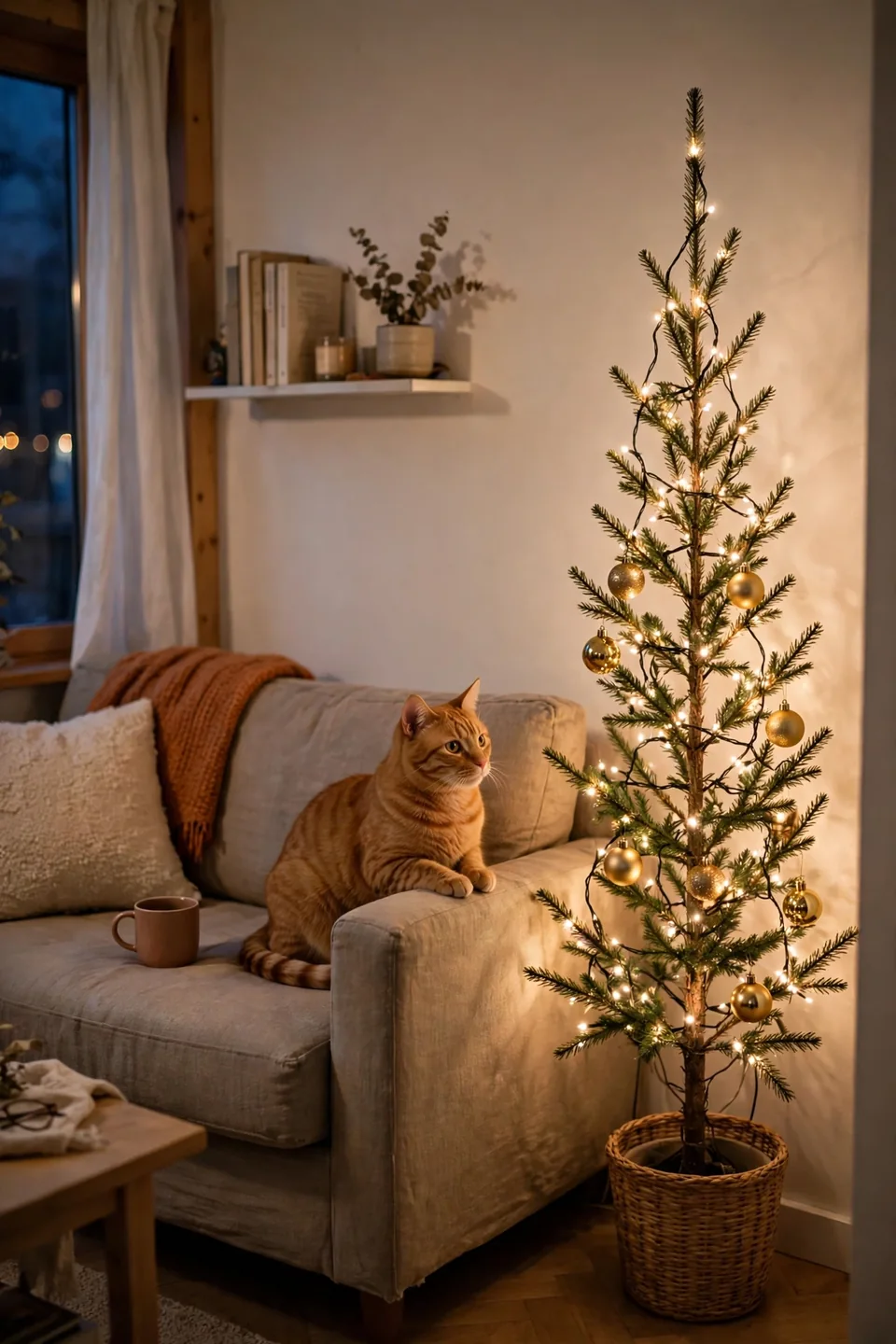
A wide, full tree is a ladder. A slim pencil tree is a pole with decorations, and most cats give up on it after one inspection.
Pencil trees are usually 12 to 18 inches across at the base, so they fit the corner beside the sofa that a normal tree would swallow. The branches are short and close to the trunk, which means fewer launching platforms and far less room for a cat to get inside the tree and hide.
Decorate it fully, lights included. Slim does not have to mean sad. It just means the silhouette suits a small room and a determined cat.
🐾 Cat test: Put the tree in a heavy basket or weighted pot so a brushing cat cannot walk it across the floor.
3. Hang a Flat Twig Tree on the Wall Instead

Image credit: @savvygrrlie — Instagram
No floor tree, no fallen tree. A wall tree made from twigs, driftwood or dowels tied in a triangle gives you the shape, the lights and the baubles, with nothing standing on the floor for a cat to charge at.
Tie graduating lengths of wood together with twine, wrap the rungs with a short garland, add battery fairy lights and hang a few shatterproof baubles from the branches. The whole thing hangs from one removable hook, so it is renter safe and needs no nails if you use a strong adhesive hook rated for the weight.
Hang the lowest rung above leaping height from any nearby furniture. A wall tree beside the sofa arm is just a shelf to a cat, so give it clear air on every side.
🐾 Cat test: Keep baubles wired or tied on, not hooked. A tied bauble swings and stops; a hooked one becomes a toy on the floor.
4. Anchor It and Weight It: The Two-Part Anti-Topple Fix
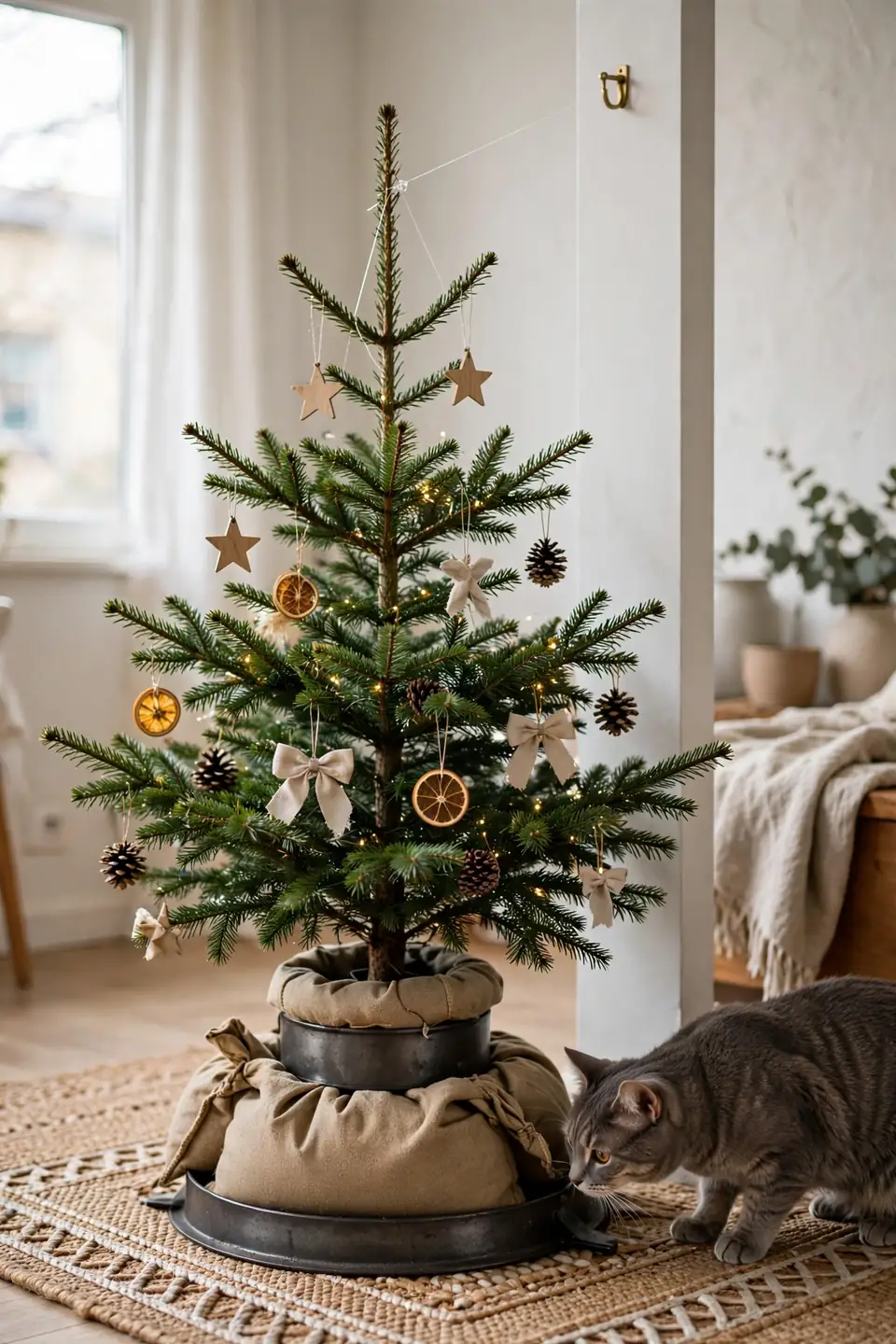
Most trees do not fall because the cat is strong. They fall because a light stand meets a moving cat at exactly the wrong angle. Fix the two weak points separately.
First, weight the base. Use the widest, heaviest stand you can fit, then add a sandbag collar or a ring of bricks hidden under the tree skirt. Second, anchor the top: run clear fishing line from the upper trunk to a small hook on the wall behind the tree. The line is nearly invisible, and it stops a slow lean long before it becomes a crash.
Do both and the tree can survive a cat landing in the middle branches, which is the real-world test every November.
🐾 Cat test: Check the line after the first day. If it has gone slack, the tree has shifted and needs reseating in the stand.
5. Buy the Cat a Christmas Tree of Its Own

Image credit: @charlies__army — Instagram
The smartest cat proofing is not a barrier. It is a better offer. A Christmas-tree-shaped cat tree, with tiers to sit on and a cubby or two, gives the cat its own festive tower right next to yours.
Set it up a few days before the real tree appears, so the new territory is claimed and boring by the time the interesting tree arrives. A sprinkle of catnip on the platforms on day one speeds up the adoption.
In a studio, this can even replace a regular cat tree for the season, so you are not adding furniture, just swapping it for a seasonal version.
🐾 Cat test: Position it between the cat’s usual route and the real tree. Cats stop at the first good perch that is actually theirs.
6. Or Skip the Floor Completely: Hang the Tree From the Ceiling

Image credit: @cmm.2009 — Instagram
It sounds like a joke photo, and it is also a genuinely unbeatable system. A tree suspended upside down from a ceiling hook cannot be climbed, batted or toppled, because there is no up and no down for the cat to exploit.
Use a lightweight artificial tree, a proper ceiling hook into a joist if your lease allows it, or a strong removable hook for a half-size tree. Decorate with shatterproof pieces only, wired on tight, because everything hangs and sways a little.
Your cat will still supervise from below, as this orange supervisor demonstrates. Supervision is fine. It is the climbing you are designing out.
🐾 Cat test: Keep the lowest branch tip at least a full leap above the tallest nearby furniture, not just above the floor.
7. Decorate Only the Top Two-Thirds

Here is the quiet compromise most cat owners land on by year two: the bottom third of the tree is the cat’s, the top is yours.
Leave the lowest branches completely bare. No baubles, no beads, nothing dangling at paw height. Put every ornament, light cluster and keepsake above the line a standing cat can reach with a stretched paw, roughly the top two-thirds of a standard tree.
From across the room the tree still reads as fully decorated, because eyes go to the top. From the cat’s level there is simply nothing worth attacking, and most cats accept the truce.
🐾 Cat test: Lights can stay wound through the whole tree if the wires are tucked deep. It is the hanging, swinging things that trigger the pounce.
8. Size Down: A Short Tree Tucked Into a Corner

Image credit: @laurawa314 — Instagram
A 3 to 4 foot tree is not a compromise in a small apartment. It is the right size, and it comes with a cat bonus: less height means less leverage, and a short tree in a stand is much harder to pull over.
Tuck it into a corner so two walls brace the space around it, and let the cat have the tree skirt. Most cats, given a warm skirt at the base and nothing swinging at nose height, will choose the nap over the climb almost every time.
Shorter also means cheaper, faster to decorate and one small box of storage in January. In a rental, that trade is worth making on purpose.
🐾 Cat test: If your cat still climbs, a short tree plus the anchor line from idea 4 is close to unbeatable.
9. Lift the Tree Onto a Dresser, Out of Pounce Range

Tabletop trees fail when they sit on tables the cat already owns. Put the same small tree on a tall dresser or high shelf instead, somewhere the cat has no route and no reason to be.
The rule is simple: no launch pad nearby. If a chair, sofa back or cat tree sits within one jump of the surface, the tree is not out of reach, it is just on a stage. Clear the approach and a 2 to 3 foot tree up high is safer than a big tree on the floor.
Use battery lights so no cord dangles down the furniture front as an invitation.
🐾 Cat test: A tree on furniture also gets seen more. Eye-level beats floor-level in a small room.
10. Stack Wooden Crates Into a Tree the Cats Are Allowed to Sit In

Image credit: @silverylizard — Instagram
This is the opposite strategy: build a tree-shaped tower the cats are officially invited to climb, sit in and sleep in. Stacked wooden crates in a pyramid, trimmed with garland, fairy lights and pinecones, read instantly as a Christmas tree.
Screw or strap the crates together so the tower cannot shift, line a few with blankets, and let each cat claim a floor. There are no needles to eat, no water to drink and nothing that shatters.
It works best in a multi-cat home, where the real tree never stood a chance anyway. After the holidays the crates go back to being storage, so nothing extra lives in your closet.
🐾 Cat test: Put the sturdiest, widest crates at the bottom and test the tower with your full weight on each tier before the cats do.
11. Swap Glass Baubles for Soft, Silent Ornaments

Image credit: @sksunshine1 — Instagram
Half of tree stress is breakage stress. Take breakables off the tree and the whole season relaxes, for you and for the cat’s paws.
Felt, fabric, wood and pinecone ornaments cannot shatter, make almost no noise when batted and survive being carried off and hidden, which will happen. A mini tree dressed entirely in soft pieces, like this one with its felt birds and plush koala, can even sit low without worry.
Keep the heirloom glass pieces for a wreath or a high shelf display instead. They still get their moment, just not within paw range.
🐾 Cat test: Skip tinsel and ribbon strands entirely. They are the decorations vets warn about most, and the tree looks fine without them.
12. Hide Every Cord and Switch to Battery Lights
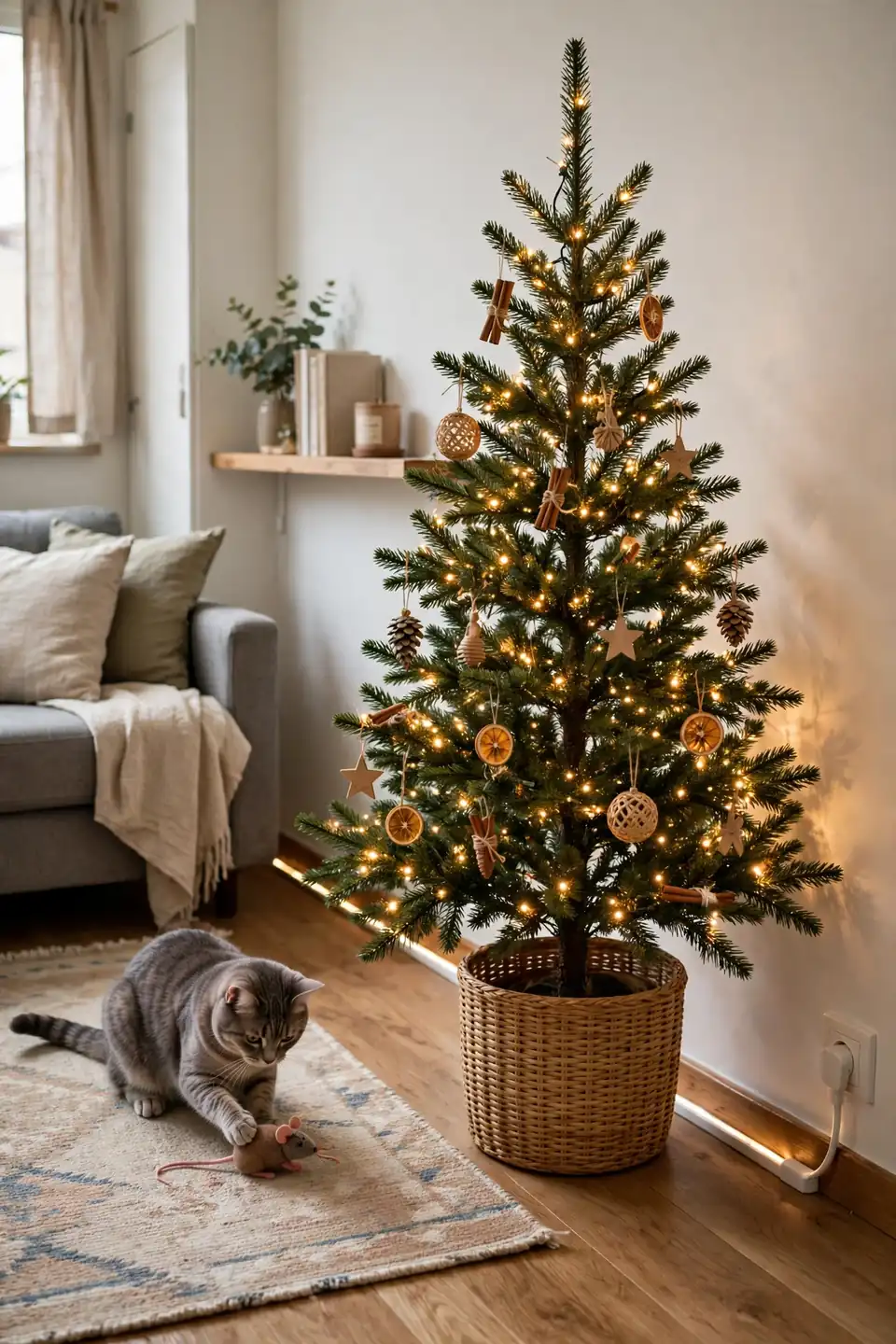
Cords are the part of the tree nobody photographs and every cat finds. A dangling light cable is a toy, a chew target and a way to pull the whole tree sideways.
Run the cord inside a slim cord cover along the baseboard, straight from tree to outlet, so nothing hangs and nothing crosses the floor. Better still, use battery-operated fairy lights on the tree itself and remove cords from the equation entirely.
Then give the cat a legal target on the rug nearby. A cat that is busy with its own toy is a cat that is not auditing your wiring.
🐾 Cat test: Unplug or switch off tree lights overnight and when you go out. Pretty is not worth a chewed live cord.
13. Turn the Cat Tree Into the Christmas Tree

Image credit: @dogmomfa_life — Instagram
If floor space allows exactly one tree-shaped object, make it the cat’s. Wrap the cat tree in garland, wind battery fairy lights around the posts, hang a stocking from a platform and let it be the festive centerpiece.
The cat keeps its territory, so there is no turf war, and you still get the glow, the green and the photo. Guests read it as charming, because it is. The cat reads it as a promotion.
Keep decorations chew-safe and lights battery powered, with the battery pack tucked inside a cubby where paws cannot worry at it.
🐾 Cat test: Photograph it at dusk with the room lights low. A decorated cat tree genuinely holds its own next to any real tree.
14. Pick a Wooden Shelf Tree With Nothing to Shred

Image credit: @furnature.ae — Instagram
A flat-pack plywood tree is the minimalist answer: a tree-shaped set of shelves that slots together, holds your ornaments on display and offers a cat absolutely nothing to climb, chew or pull down.
Dress the shelves with the soft and wooden ornaments from idea 11, a short string of battery lights and maybe the cards you receive. Everything sits flat and stable instead of hanging and swinging.
It suits a rental especially well. No needles, no water, no stand, and in January it unscrews or unslots into a flat bundle that slides under the bed.
🐾 Cat test: Put one low shelf aside for a cat bed or a plant the cat ignores. A shared piece of furniture gets investigated once, then accepted.
15. Give the Cat a Festive Window Seat of Its Own

Image credit: @teefie_tribe — Instagram
Finish where cat logic actually lives: the window. A window perch dressed with a little garland and a set of fairy lights on the cat tree gives your cat a holiday spot that competes with the tree and usually wins.
Cats choose warmth, height and a view over almost everything. A sunny perch with a soft pad beats a prickly tree full of rules, as long as the perch is set up before the tree goes up and the routine sticks.
Pair this with any other idea on the list. Cat proofing works best in layers: one barrier, one rule and one very good alternative.
🐾 Cat test: Feed dinner or offer the best treat at the perch for the first few evenings. You are building a habit, not winning an argument.
The Layer Rule: Why Two Fixes Beat One Big One
No single trick on this list is magic, and any cat can beat any one system on a determined afternoon. What works is layers: something physical (a barrier, an anchor, height), something boring (nothing dangling, nothing breakable) and something generous (a perch, a cat tree, a nap spot the cat prefers). Pick one from each group and the tree stops being the most interesting object in the room.
Set everything up before the tree goes up, ideally a day or two ahead, so the new rules and the new cat furniture are already normal when the main event arrives. Cats accept routines far more easily than they accept changes.
Still choosing a tree? See these Christmas tree ideas for a small studio, these IKEA Christmas hacks and these small Christmas living room ideas. The ASPCA’s holiday pet safety tips list plants and treats to keep away from cats.
Cat-Proof Christmas Tree Questions, Answered
What is the most cat proof Christmas tree?
For most small apartments, a slim or wall-mounted tree with shatterproof ornaments and an anchored, weighted base. If your cat is a serious climber, a tree behind a barrier (idea 1) or hung from the ceiling (idea 6) is the closest thing to unbeatable.
Are real trees safe for cats?
Pine needles can irritate a cat’s mouth and stomach, and tree water is not safe to drink, so cover the stand and sweep needles daily, or choose a good artificial tree and skip both problems. Never use tinsel; it is the decoration vets warn about most.
How do I stop my cat climbing the Christmas tree?
Remove the rewards and add a better option: bare lower branches, wired-on shatterproof ornaments, a fishing-line anchor, and a cat tree or window perch placed nearby and set up first. Most cats quit within a few days once the tree becomes boring and the alternative is comfortable.
Do citrus sprays and deterrents work?
Many cats dislike citrus smells, and a little orange peel at the base costs nothing to try, but habits and setup beat sprays. Never use essential oils around cats, and skip anything your cat could lick off its paws.
However you set it up, take the photo on the first evening, while the tree and the cat are both still impressed. By January, both of you will have forgotten there was ever a battle, and the tree will just be the corner where the cat naps. That is the real win.
Free Download
Get the Renter-Safe Decor Checklist
20 landlord-approved products and tricks I use in every small space project, sent straight to your inbox.






One Comment