Window Privacy Ideas for Apartments: 15 Easy Ways to Still Love Your Light
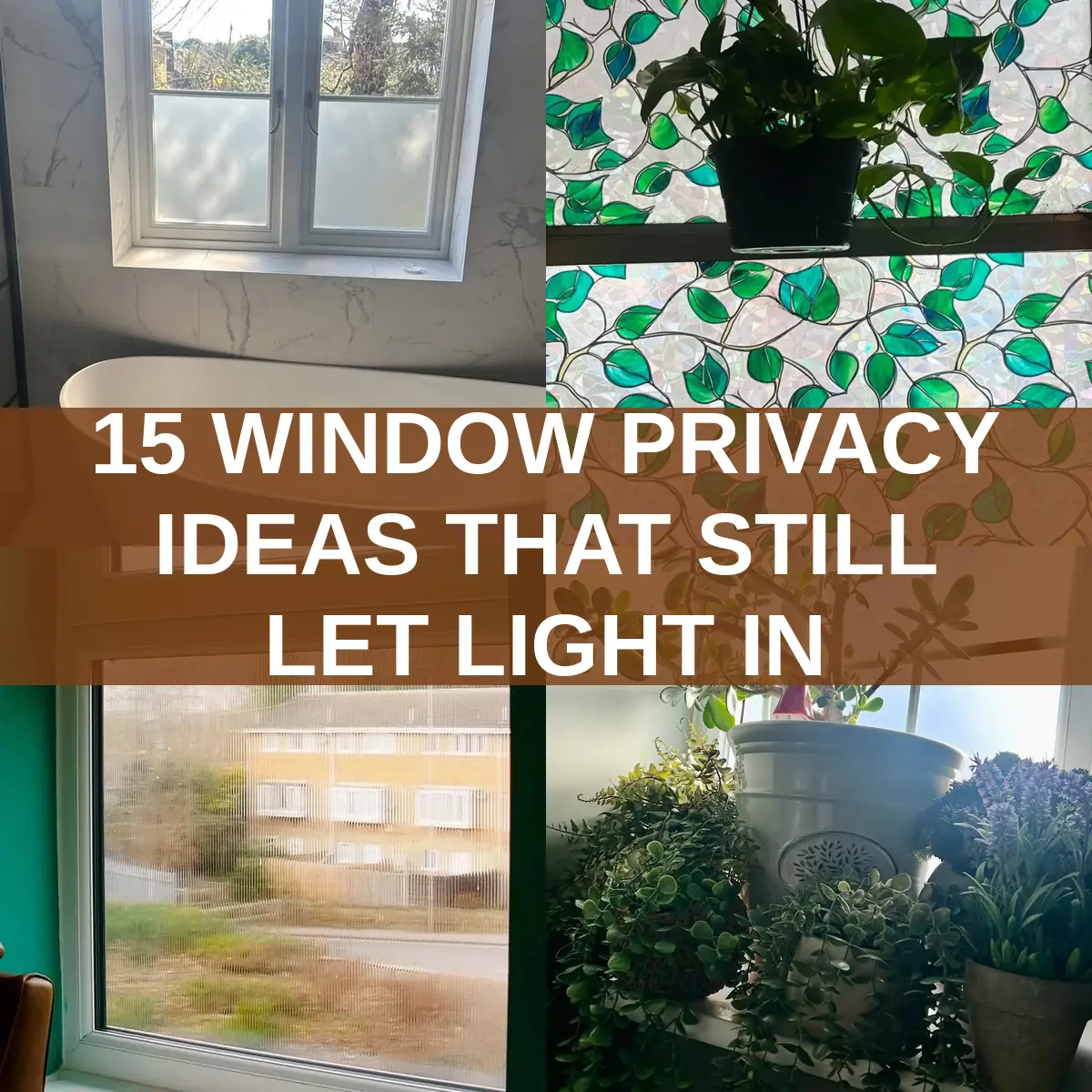
Good window privacy ideas for apartments start with one fact: apartment windows face other apartment windows. They face the street, the stairwell, the neighbor’s balcony and the exact spot where the bus stops every morning. The usual fixes give up too much: heavy curtains that eat the daylight, blinds kept shut for three years, or a bathroom window treated like a porthole on a submarine.
Privacy and light are not opposites, though. Privacy only needs the eye-level slice of the glass, the band a passerby can actually see through, and daylight mostly arrives from the top of the window anyway. The 15 window privacy ideas apartment renters lean on most are gathered below: films that stick with water and peel off clean, shades that park at any height, cafe curtains, and one screen that needs watering.
Every idea here is removable or drill-free, because a deposit is part of the brief. Some cost less than a pizza. A few need a free afternoon and a spray bottle. All of them leave the window able to do its first job, which is letting the day in.
Start Here: Privacy Is a Band, Not a Blanket
Hold one hand up at the window, at the height of your eyes, and move it slowly down to your knees. That strip is the whole problem. Everything above it is sky, and everything below it is usually a wall, a sill or a hedge. Most of this list screens only that strip, in one material or another, and charges you nothing in daylight for doing it.
1. Frosted Film on the Lower Panes Only
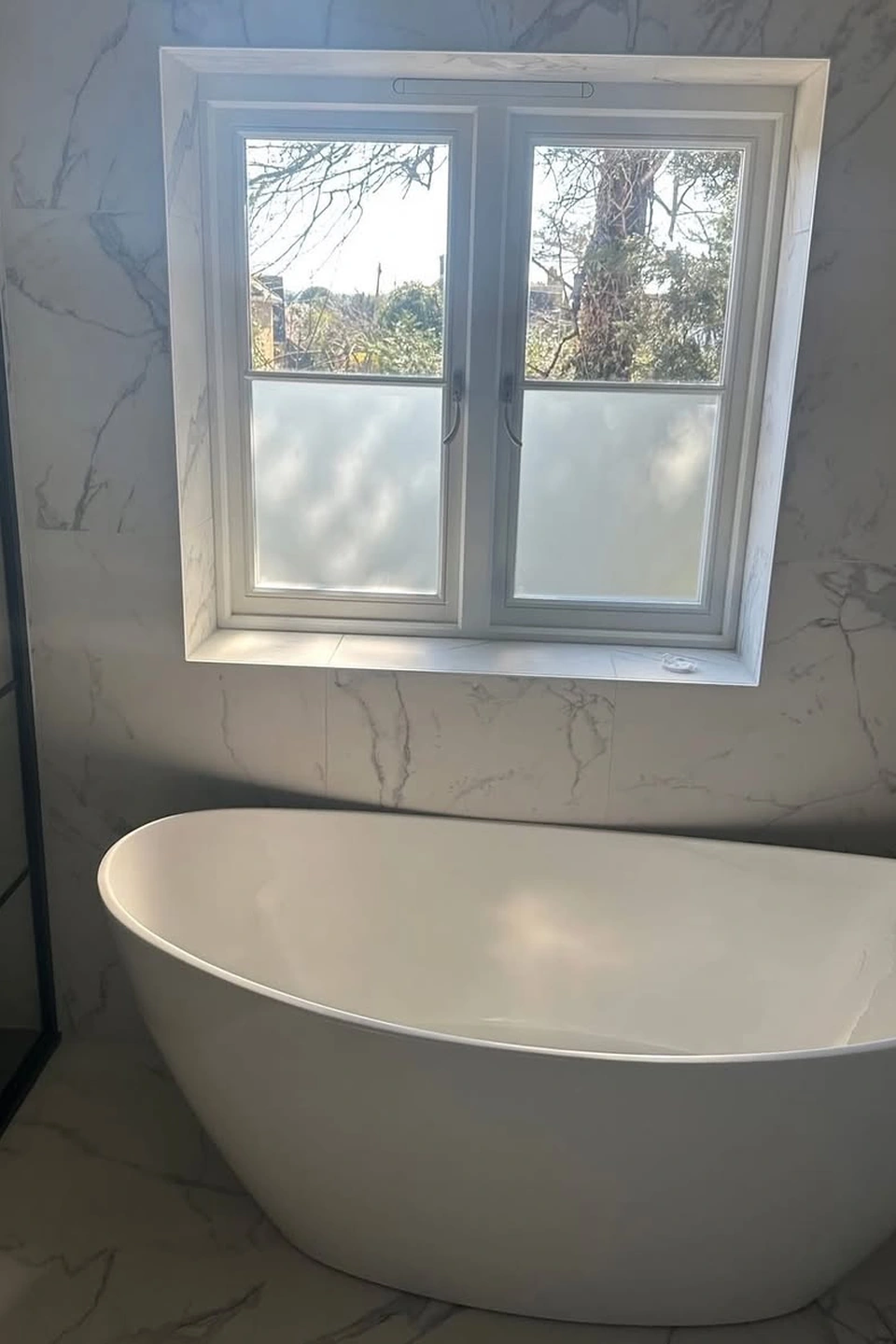
The most useful square meter of film in this whole list covers half a window. In this marble-tiled bathroom, the two lower panes of a tall window wear a plain frosted film and the two upper panes stay clear, so the freestanding tub below gets its screen and the room keeps its view of the trees. From the street, a person standing at that glass would be a soft shape at worst. From inside, the light barely notices the change.
Half-height film suits any window where the overlooking happens at ground level: bathrooms over a side path, living rooms on a raised ground floor, kitchens facing a shared yard. Measure the sightline before you measure the glass. Stand outside at the worst angle, or get a friend to, and note exactly where the view into the room stops. Film a hand’s width above that line and no higher.
🧩 Renter test: Tape a sheet of baking paper over the lower panes for two days before you buy anything. It frosts the glass well enough to prove the height is right.
Image credit: @windowfilm — Instagram
2. Full Frost in the Shower, Where Half Measures Feel Wrong
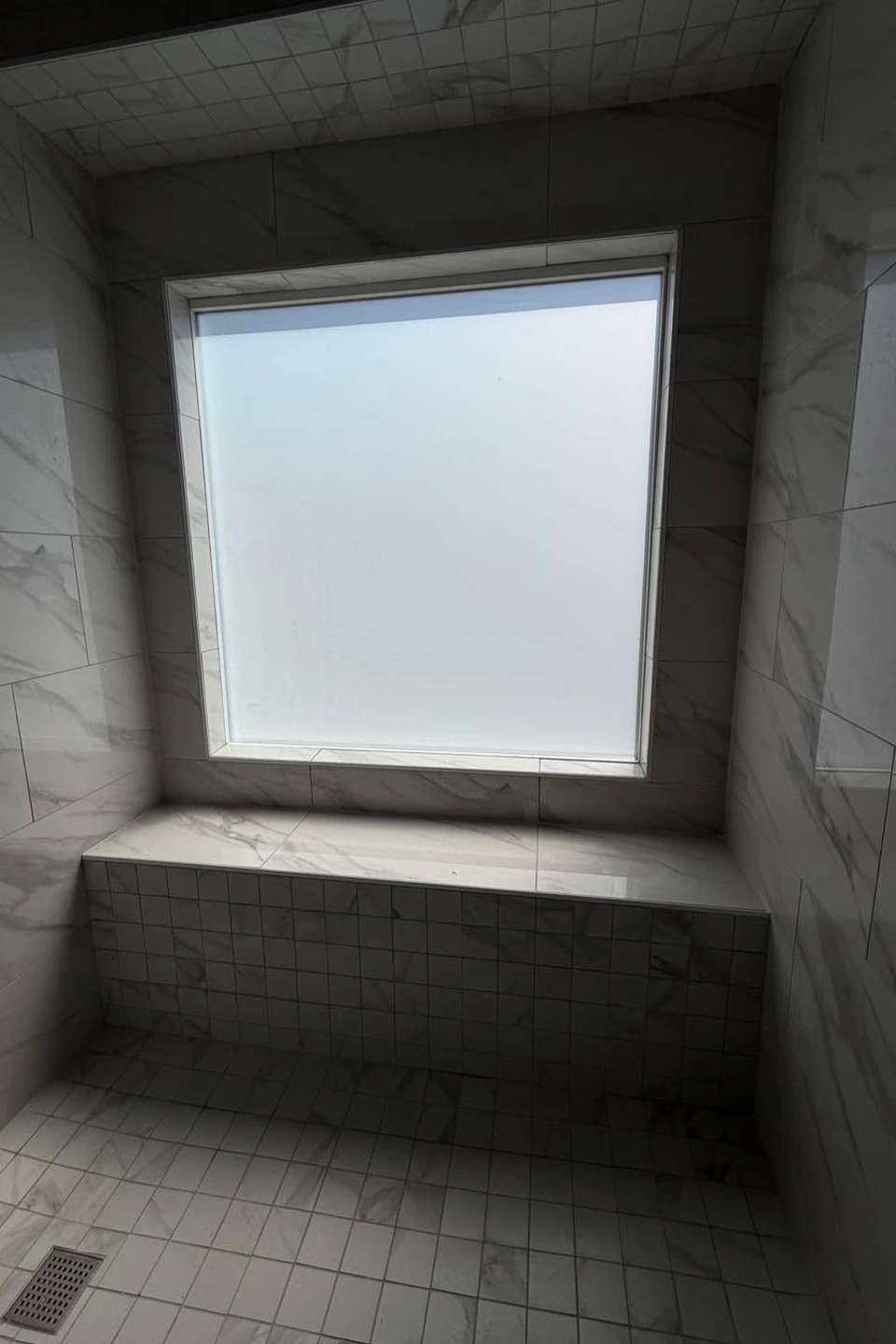
Some windows get the full treatment without an argument. This walk-in shower has one broad window over its tiled bench, frosted edge to edge, and in a wet room at body height there is no lower-half logic to negotiate. What the photo shows better than any product shot is the trade you actually make: the window stops being a view and becomes a light panel, glowing evenly while the shower runs.
Choose static-cling film here rather than an adhesive one. Shower glass runs hot and cold and drips with condensation, and a cling film can be peeled back, rinsed, and smoothed on again when an edge lifts. Cut it a few millimeters short of the frame on every side. That small gap keeps the edge out of the standing water line where lifts begin.
💡 Quick Tip
Wet glass hides film bubbles. Squeegee a shower window from the center outward, leave it an hour, then look at it dry and raking-lit from the side. The bubbles you can see at that angle are the ones worth one more pass with a bank card.
Image credit: @ontheflywindowtinting — Instagram
3. A Leaf-Pattern Film That Gives the Window a View of Its Own
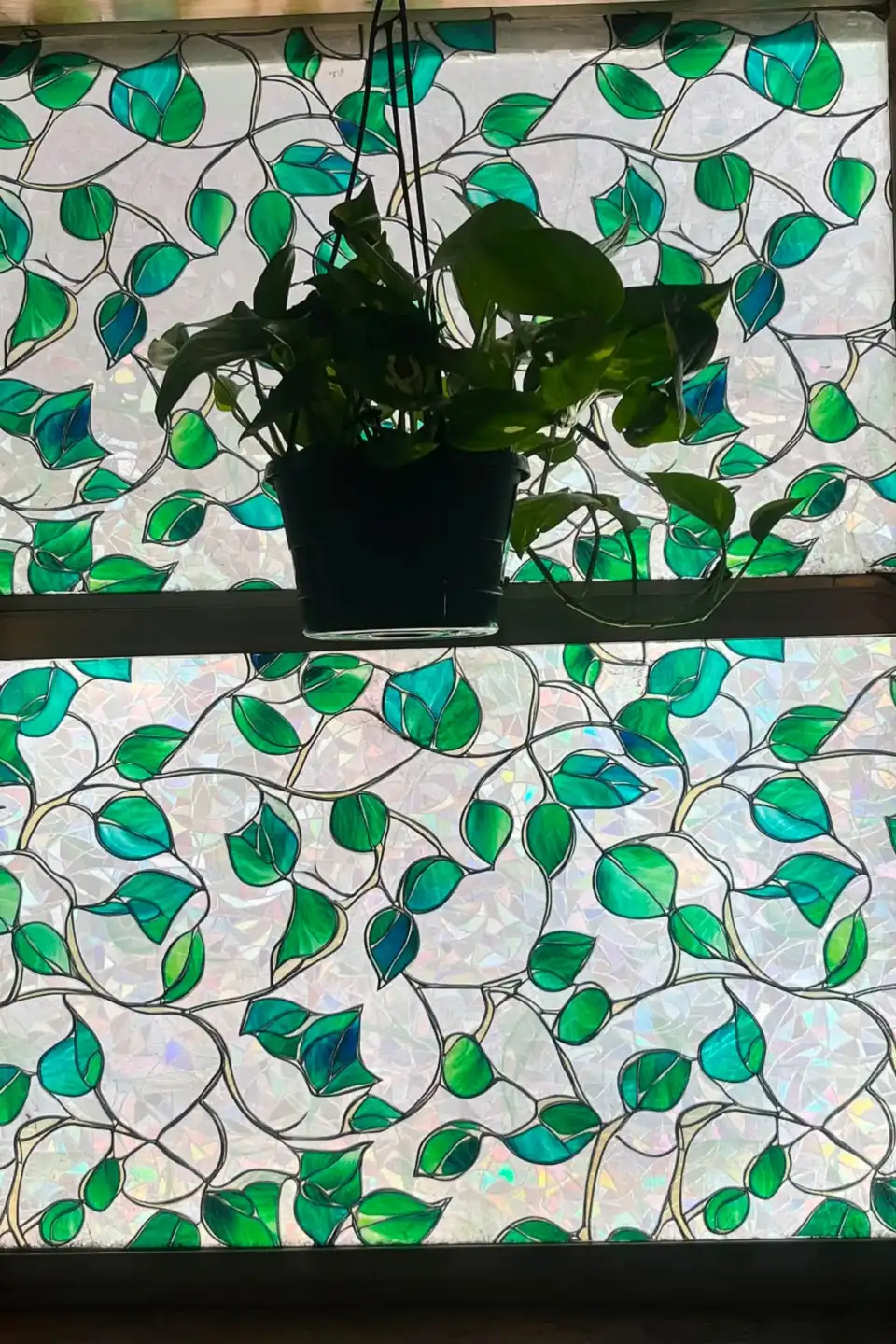
Plain frost solves the problem and stops there. A patterned film keeps going. This one runs a green vine-and-leaf pattern across the whole pane, dense enough that the glass behind it gives up its shapes entirely, and the window becomes the most decorated surface in the room. A real plant hangs in front of it, and the two greens argue pleasantly about which one is alive.
Pattern earns its keep on windows that face nothing worth seeing: a brick wall six feet away, a parking court, the side of the next building. Match the pattern’s scale to the pane. Small repeats suit small windows, and a busy print on a big pane wants a bigger motif or it starts to buzz. Order a sample first and tape it up for a full day, because a pattern you love at noon can feel loud by lamplight.
Recreate this look
Image credit: @haneycandice — Instagram
4. Stained-Glass-Look Film for a Bathroom With No Color In It
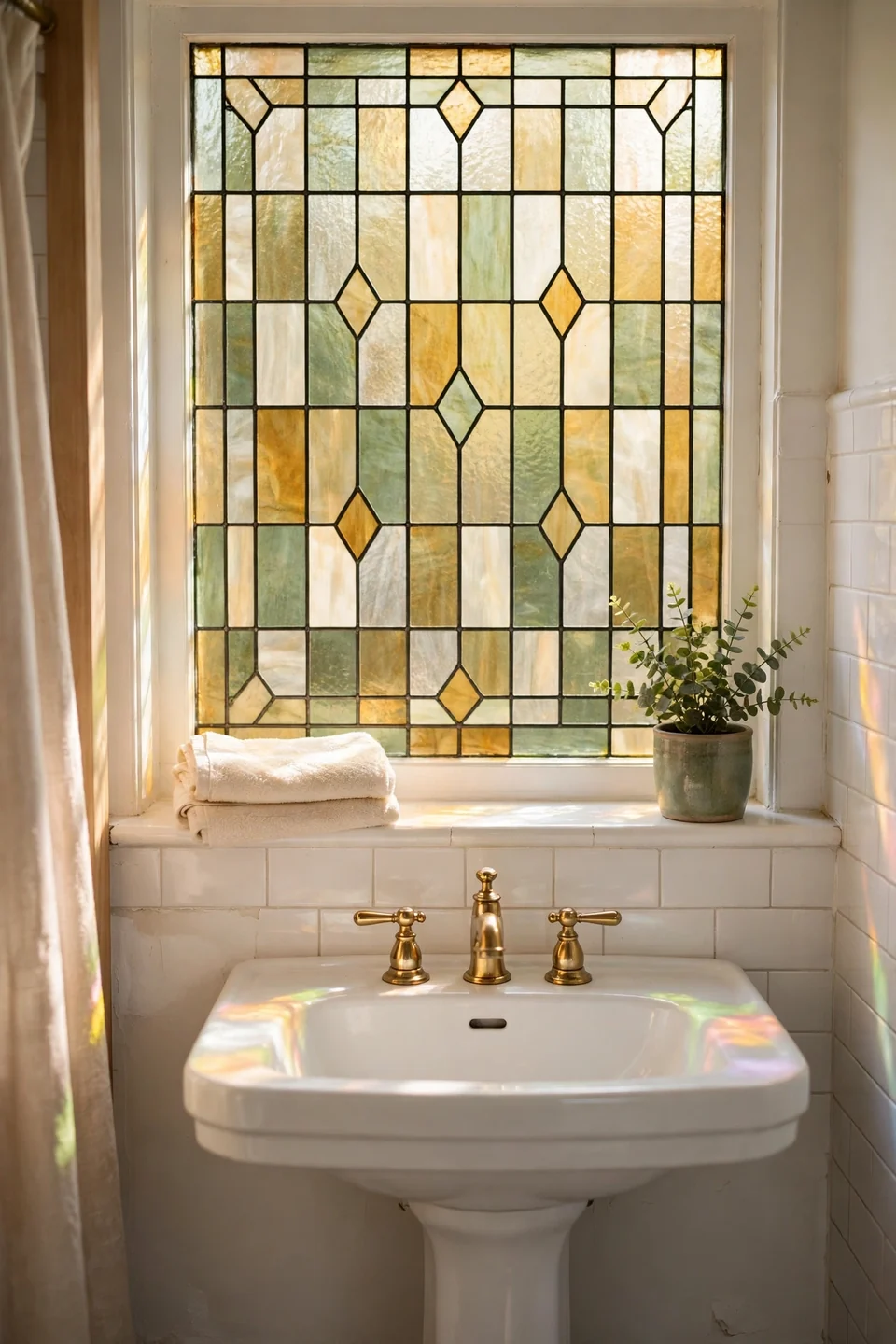
Rental bathrooms run white on white, and the window is often the one surface allowed to misbehave. A stained-glass-look film, the static kind printed with leading lines and colored panes, gives this small bathroom amber and sage over a pedestal sink without a single permanent change. The sun does the decorating: colored light pools on the tiles in the morning and moves on by lunch.
The application is the same water-and-squeegee job as plain frost, with one extra step at the measuring stage. A patterned film with a grid in it shows every crooked cut, so measure twice and trim against a straightedge on a flat table, not against the glass.
Clean the glass properly: scrape off paint specks, wash with soapy water, and dry the corners with a lint-free cloth. Film shows every crumb left under it.
Mist the glass until it drips, peel the backing, and float the film into place. The water layer is your adjustment time, so use plenty.
Squeegee from the center out, then trim the edges with a craft knife run along the frame. Leave it a full day before you judge the corners.
5. Reeded Film: The Texture That Scrambles a Street View
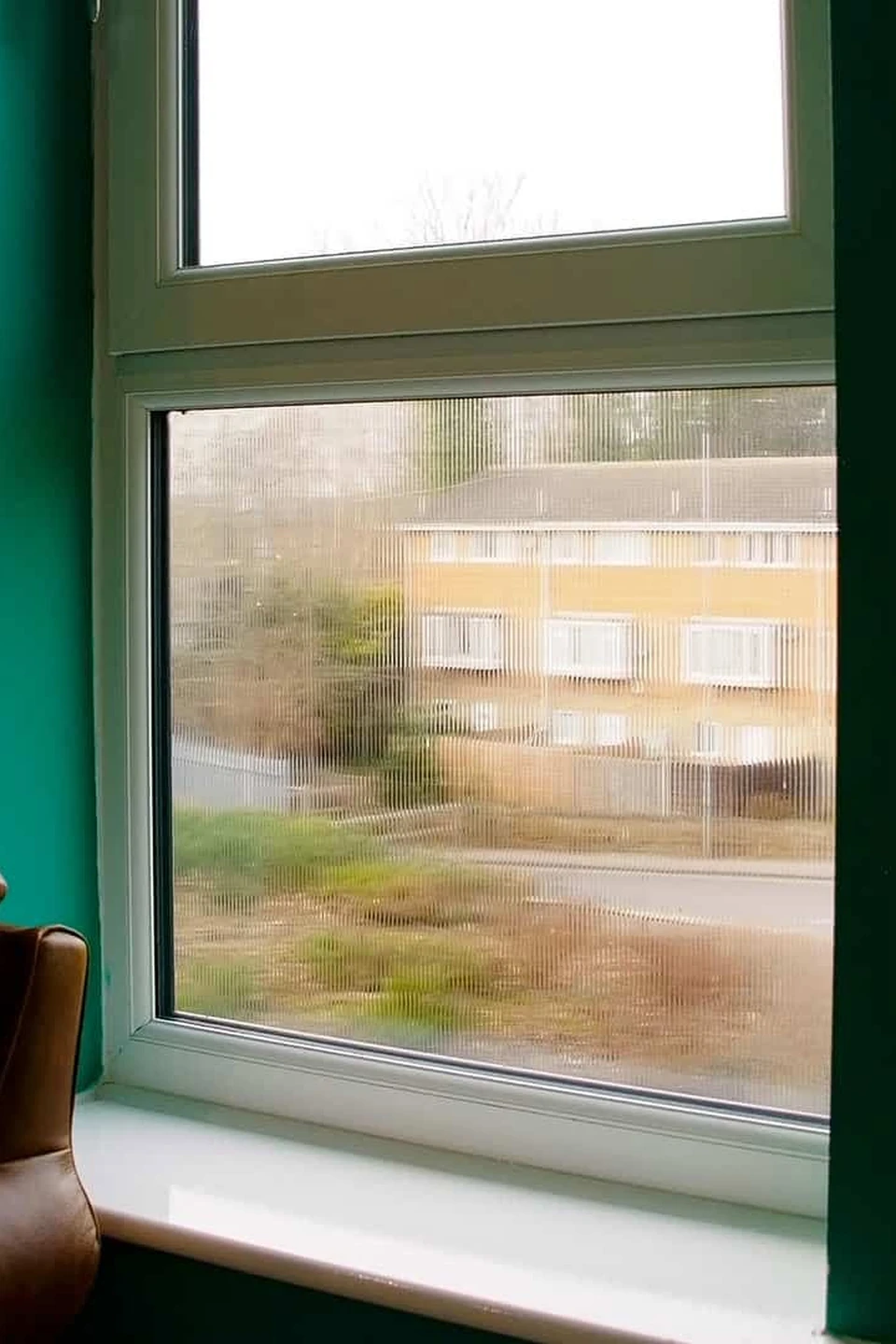
Stand in this room and the houses across the street are still there, just unreadable. Reeded film runs fine vertical ribs across the glass, and anything beyond it smears into stripes of color: brick becomes rust, hedge becomes green, a parked car becomes a rumor. It is the film to pick when plain frost feels like admitting defeat, because the window keeps its brightness and gains a texture that reads as deliberate, almost architectural.
One honest limit: reeding scrambles detail, not silhouettes. A person standing close to the glass on your side will still read as a person from the street, softly. Pair it with distance, a set-back sofa, a plant on the sill, or use it on upper floors and stairwell windows where nobody lingers close to the pane.
| Plain frosted film | Reeded film |
|---|---|
| Outside view becomes a soft white glow; shapes near the glass still show. | Outside view becomes vertical stripes of color; detail is unreadable. |
| Reads as a bathroom treatment wherever you put it. | Reads as textured glass, at home in living rooms and halls. |
| Cheapest per meter, sold everywhere. | Costs a little more; order a sample to judge the rib width. |
Image credit: @surface.designs — Instagram
6. A Geometric Print for the Bathroom Everyone Can See Into
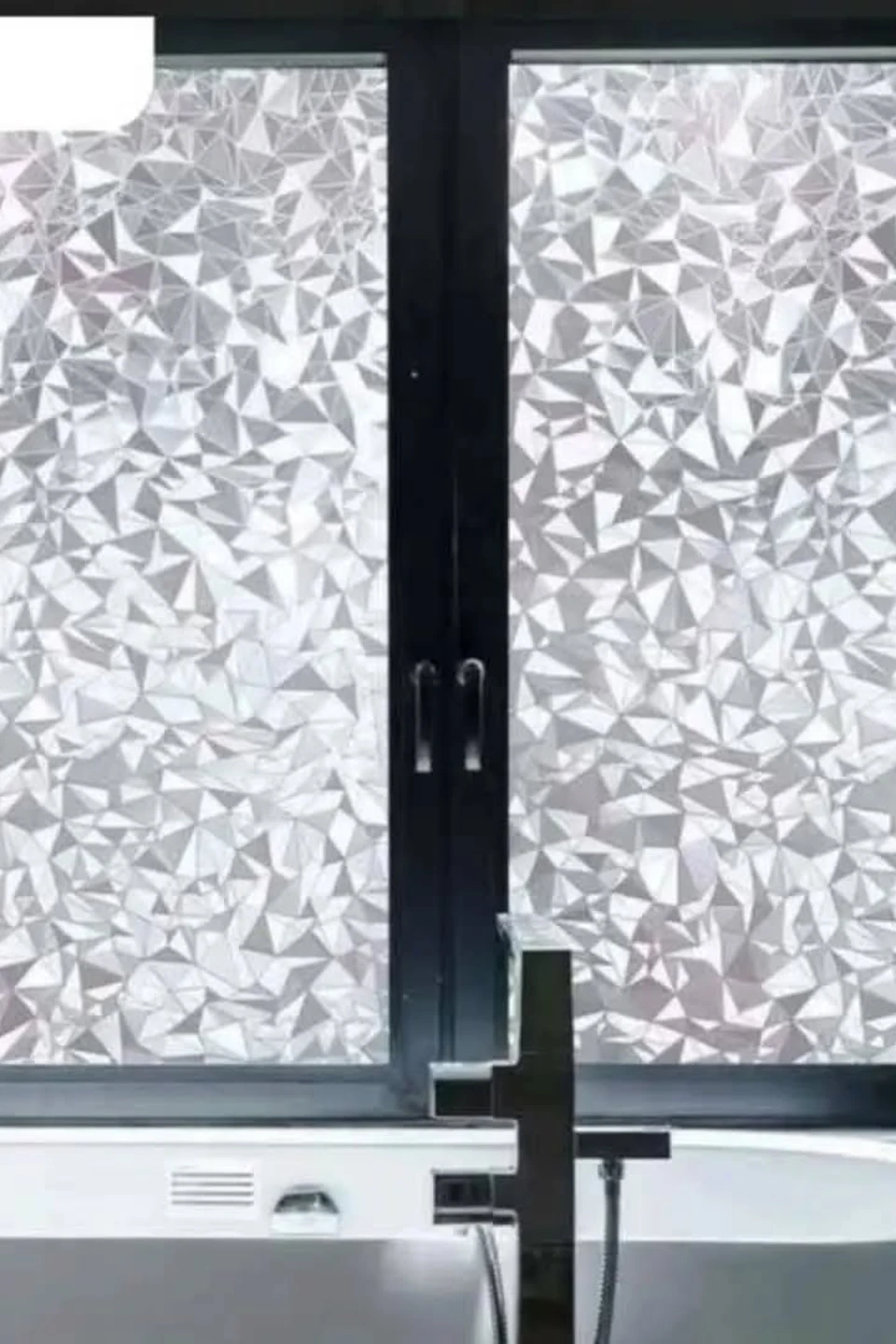
Black frames and a white tub make a strict bathroom, and the film here keeps the discipline: a grey and white geometric repeat, small interlocking shapes, spread over both tall panes above the bath. Up close it is a pattern. From the garden it is a closed door. Dense small-scale prints are the strongest privacy in this list, stronger than plain frost, because the eye cannot settle on a shape long enough to name it.
Geometric prints forgive crooked rentals. A floral shows a tilted repeat; a strict geometry reads as intentional even when the frame is a few degrees out. The one place to be careful is the join on double doors or paired panes: line the pattern up across the center post, because a half-step jump in the repeat is the one thing a tidy print cannot hide.
Match the repeat across paired panes, starting both sheets at the same point in the pattern.
Hold a sample against the glass at night with the bathroom light on, and check it from outside.
A large-scale print on a small pane. Two giant leaves per window reads as a sticker, not a treatment.
Trimming flush into wet silicone seals. Leave a hair of glass bare at the edge so the sheet can move.
Image credit: @turningpointglory — Instagram
7. Reeded Film on the Glass Doors Everyone Forgets
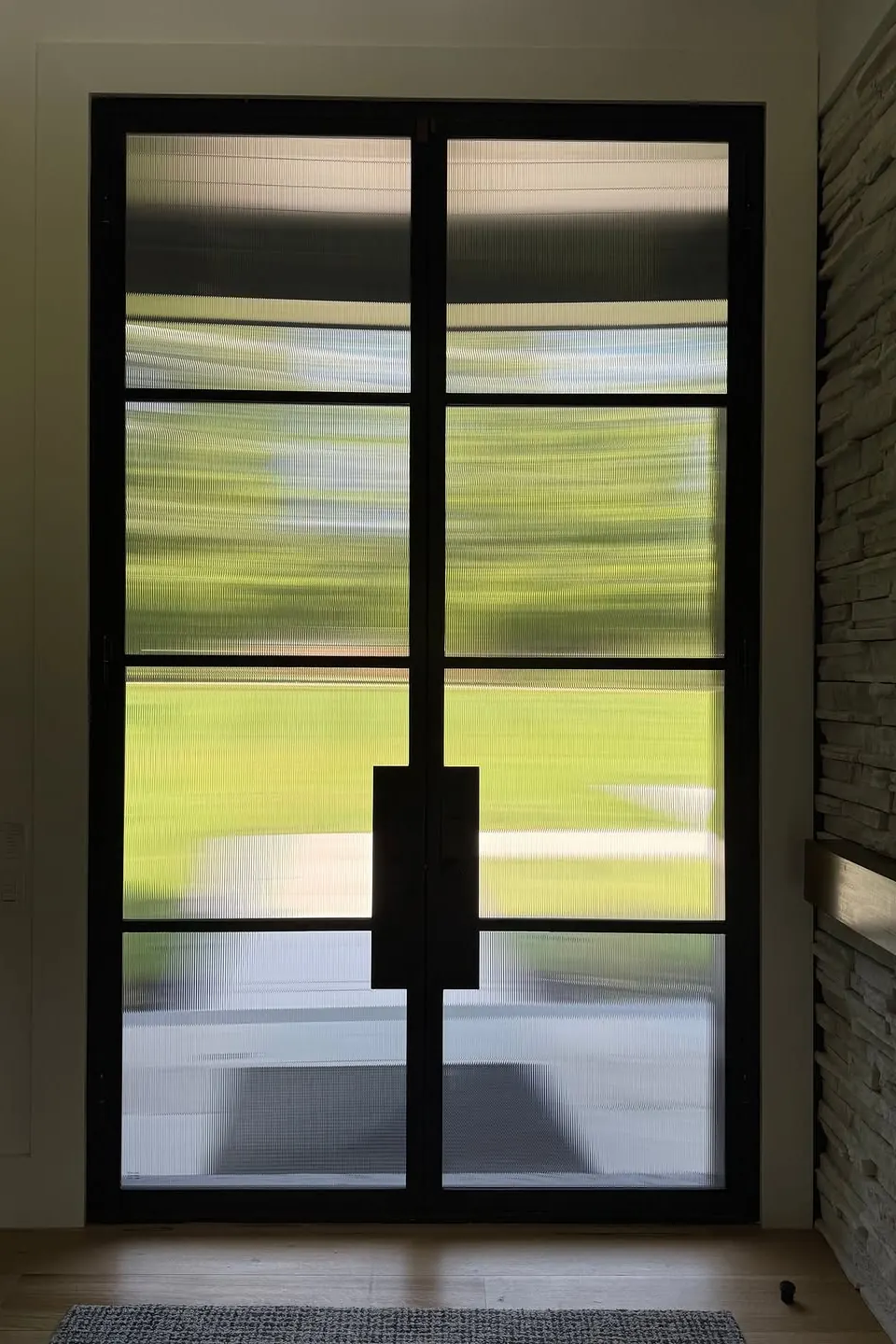
Front doors leak more privacy than windows do. A glazed door and its sidelights put your hallway, your coat hooks and your comings and goings on display at the exact height of a face. These black-framed double doors run reeded texture down every panel, and the garden beyond dissolves into green weather. Inside, the hall stays bright. Outside, a caller sees color and movement, not a person deciding whether to answer.
Film suits door glass well because it adds no weight and nothing swings, rattles or needs a track. Work panel by panel, and run the ribs the same direction on every sheet. On a door with several small panes, cut all the pieces first and lay them out in order on the floor; mixing up left and right mid-job is the classic way this project goes sideways.
Image credit: @americanwindowfilmhq — Instagram
8. Frosted Film With a Clear Band Left at the Top
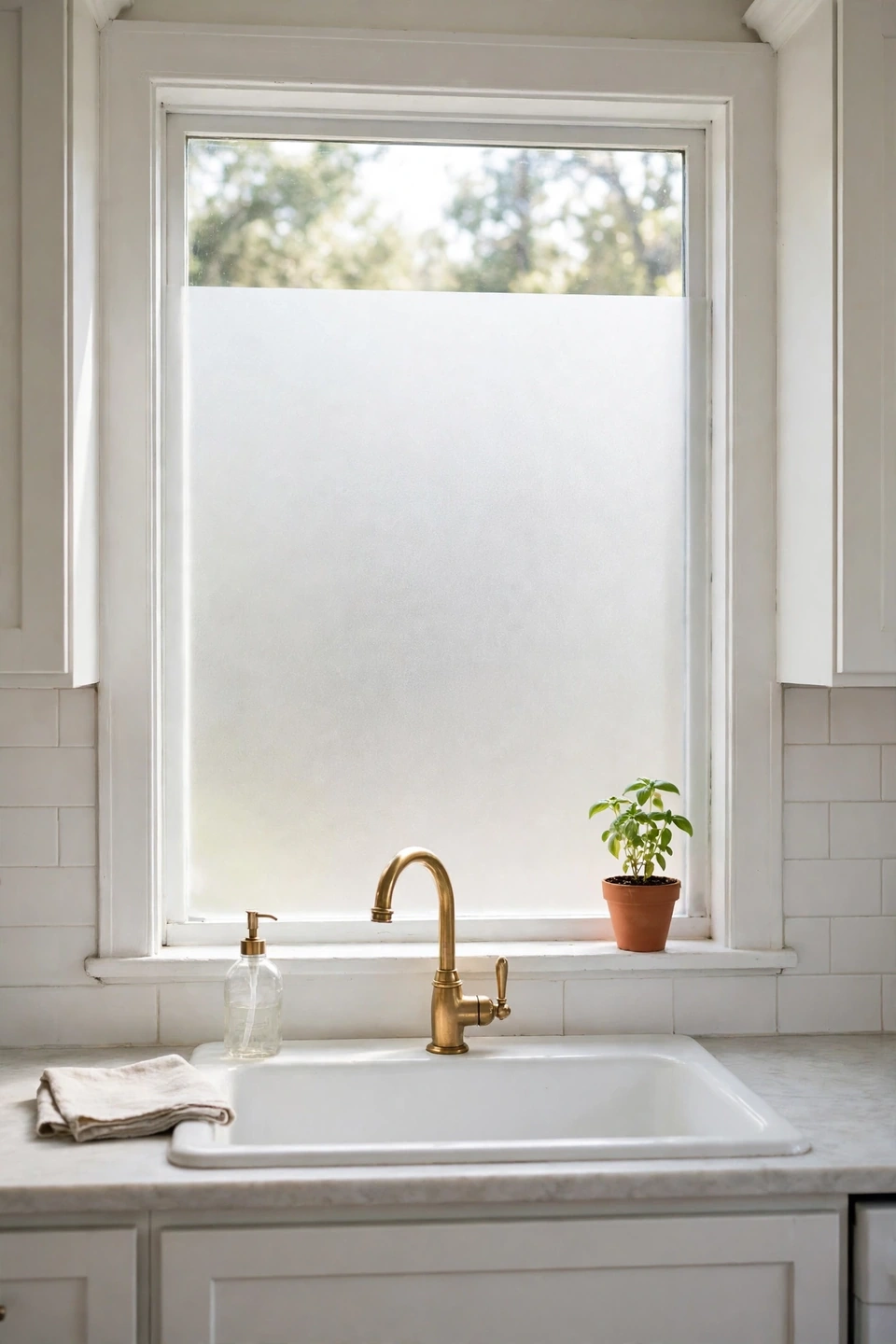
Idea 1 films whole lower panes. This one films most of a single pane and stops short, leaving a clear band of glass running across the top of a kitchen window. The effect is closer to architecture than to a cover-up: a frosted field with a clean horizon line, trees still visible above it, and the sink below screened from the path outside. The band also gives the eye a rest, because a partly clear window reads as a window, not a wall.
Getting the line level is the whole job. Mark it with painter’s tape on the outside of the glass before you cut, and step back across the room to judge it against the frame, not against the wall, which may not be straight itself. Cut the film on a table with a metal ruler. A wavy top edge cannot be un-waved later.
📌 Good To Know
A clear band works best where the view above the line is sky, trees or rooftops. If the building opposite is taller than yours, its windows look down through that band, and a full frost or a top-down shade from this list is the safer pick.
9. A Cafe Curtain in the Bathroom, for Anyone Who Finds Film Too Final
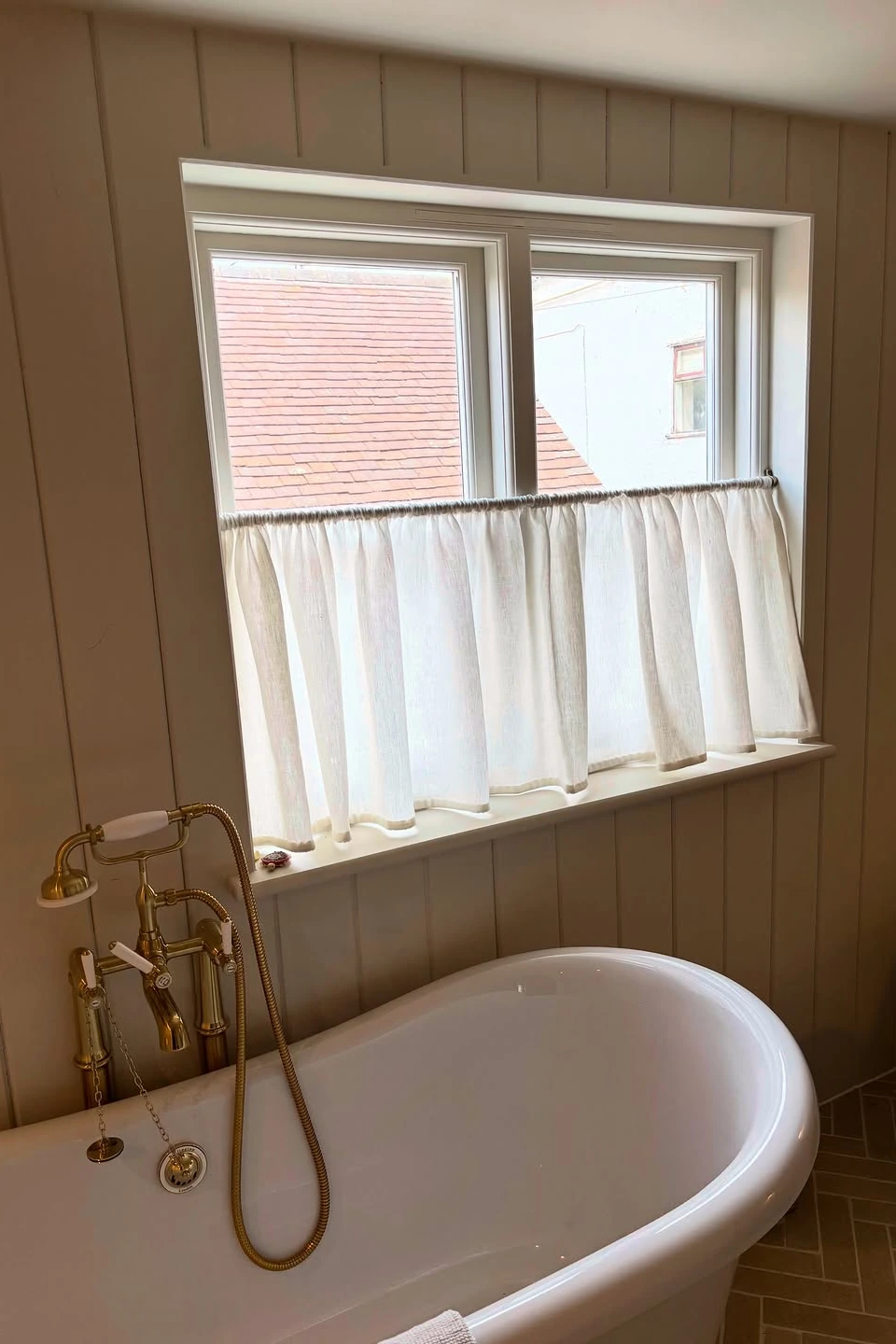
Film is a decision. Fabric is a mood. Over this clawfoot tub, a plain white cafe curtain covers the lower half of the bathroom window and leaves the top open to the sky and the rooftops, and the room reads softer for it. The brass taps and the roll top do the period styling; the curtain just has to be white, washable and the right length.
Bathrooms are hard on fabric, so choose like it matters: cotton or a cotton blend that tolerates a hot wash, hung where the shower spray cannot reach it, with a hem that clears the sill by a finger. A cafe curtain in a steamy room wants airing, so hang it on a rod it can slide along and open it with the window after a shower. On a rental frame, a slim tension rod inside the reveal does the job with no fixings at all.
Measure from the middle rail of the frame to a point just below the sill. The curtain should end at the sill line, not pool on it.
Fit a tension rod inside the frame at mid height and thread the curtain on before you seat the rod. Bathroom rods fitted after the fabric are where drips and swear words start.
Wash the curtain before its first hang and again monthly. Cotton shrinks a little and bathroom dust is real; a curtain washed on schedule stays white for years.
Image credit: @jocelynberryinteriors — Instagram
10. A Lace Panel: Old-Fashioned on Purpose
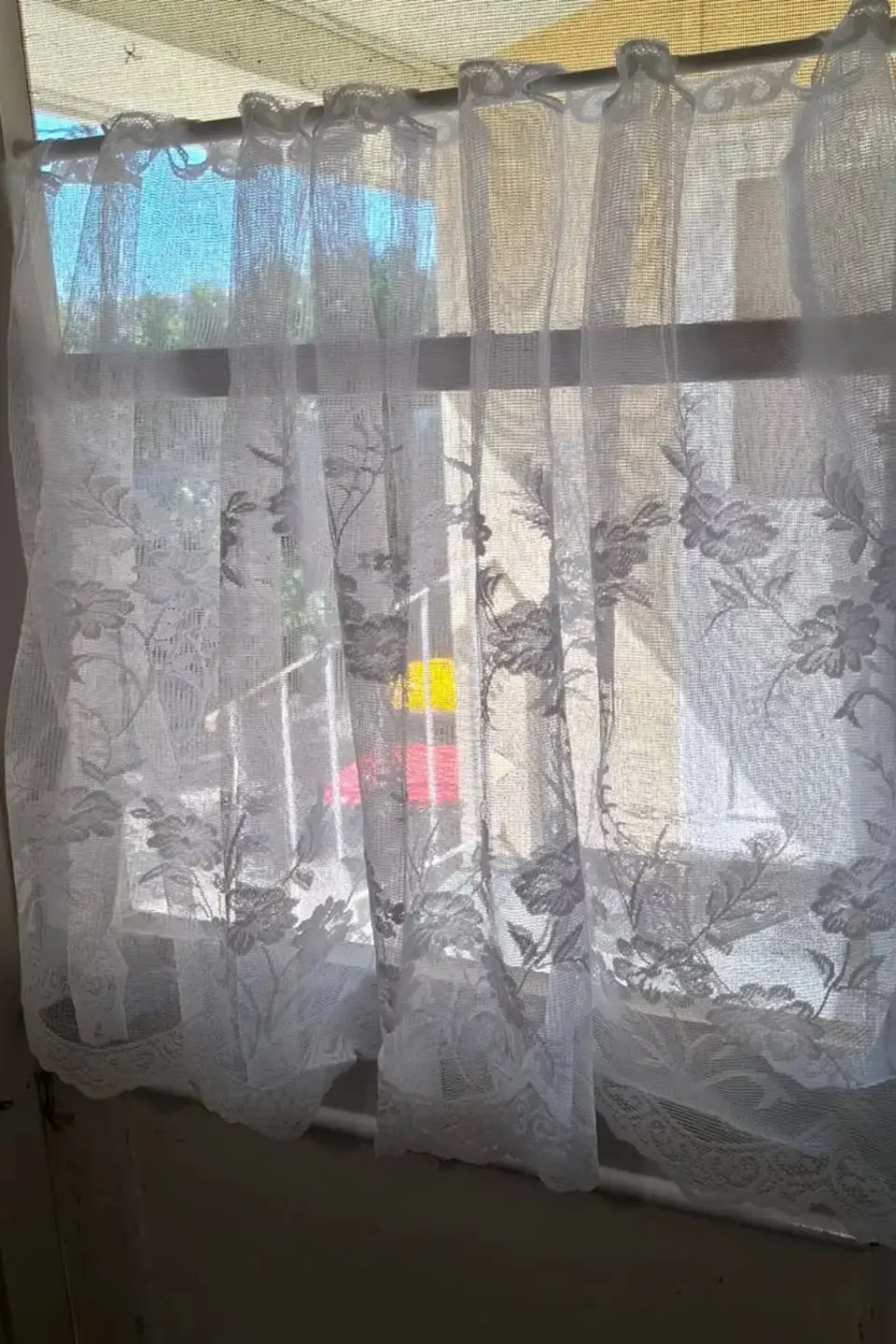
Lace solves privacy the way a net curtain always has: a pattern dense enough to break up a view, open enough to pass the light almost untouched. This white floral panel fills its window edge to edge, and the daylight comes through the gaps in the pattern as much as through the thread. From the street, the window is white lace and nothing behind it. From the sofa, it is the softest light in the flat.
Lace has shaken off its fussy reputation by going plain: one color, a simple floral or leaf repeat, no frills, no swags. Buy it by the meter and hem it with iron-on tape if sewing is not your trade. It is also the lightest treatment in this list, so it hangs happily from the thinnest tension rod or a length of curtain wire, and it washes in a pillowcase without complaint.
Recreate this look
Image credit: @faeriekitteh — Instagram
11. A Top-Down, Bottom-Up Shade: Park It Where the Eyeline Is
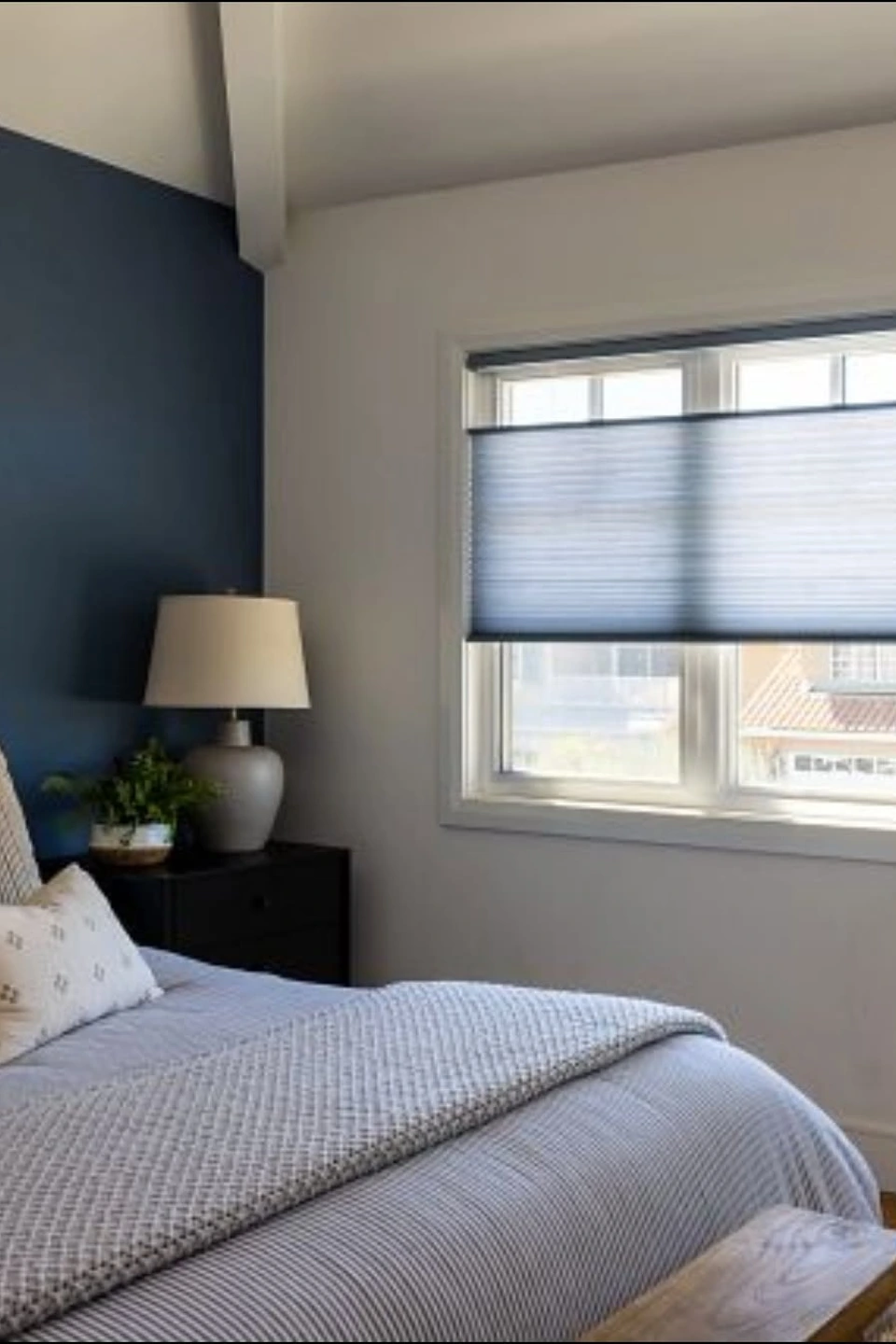
Most shades only know two positions: up, and down over everything. A top-down, bottom-up shade travels. Its rail can drop from the top of the frame, rise from the sill, or park anywhere in between, and this navy-walled bedroom shows the fabric mid-journey, covering one band of glass while the rest stays open. Park it over the lower half and the street loses its view while the sky keeps its shift. Float it in the middle and the window wears a soft horizontal stripe of light.
For a renter, the mount decides whether this idea is available at all. Many of these shades now come in no-drill versions that grip inside the frame or fix to the glass with adhesive pads rated for the weight. Check the pad type before you buy, fit it on a warm day so the adhesive bonds, and give it a full day before the first pull. Fitted that way, the shade leaves with you and the frame keeps its secret.
🧩 Renter test: Measure the frame’s depth before ordering. Inside-mount shades need a minimum reveal, and a window that opens inward may rule the fit out entirely.
Image credit: @3dayblinds — Instagram
12. A Sheer Over a Plain Roller Blind: The Night Shift
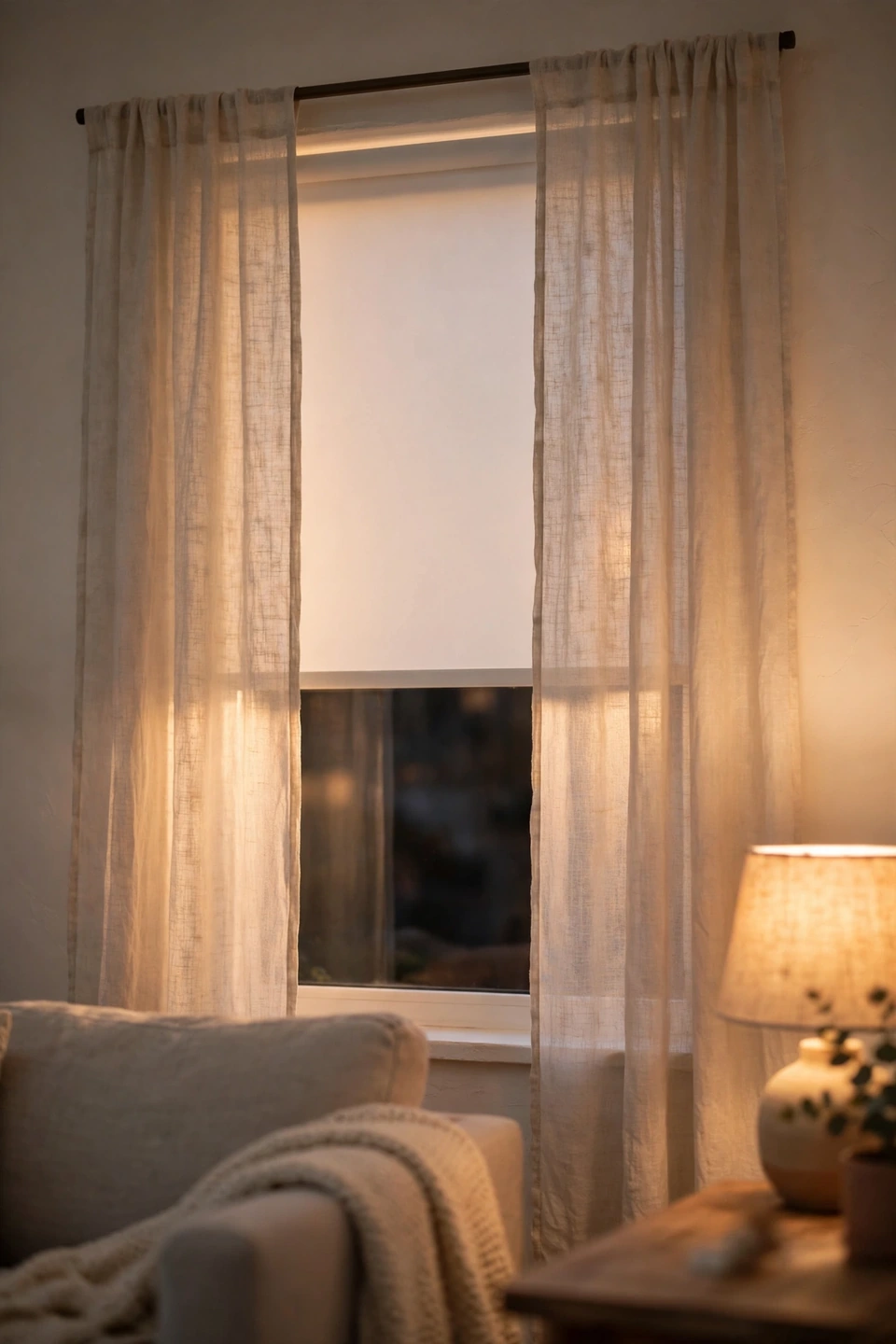
Every sheer in this list has a curfew. By day it is a one-way screen; by night, with your lamps on and the street dark, it shows the room’s shapes to anyone passing. The fix is a second layer with a different job. Here a plain white roller blind sits behind sheer linen curtains, and the two divide the day between them: the sheer handles the bright hours and softens the blind’s plainness, and the blind rolls down at dusk and takes the night shift alone.
The blind is also the cheapest insurance in the article. A basic roller costs little, needs no care beyond a wipe, and turns any decorative treatment in front of it into a fully private one on demand. Order the blind in the same white or cream family as the sheer so the pair reads as one decision, and mount the blind inside the frame so the curtain keeps the outside line clean.
⚠️ Watch Out
Test your sheer honestly before you trust it. Stand outside after dark with every light in the room on and look at your own window. If you can name the furniture, the street can too, and the blind behind it stops being optional for that room.
13. A Bottom-Up Shade for the Tub That Sits Under the Window
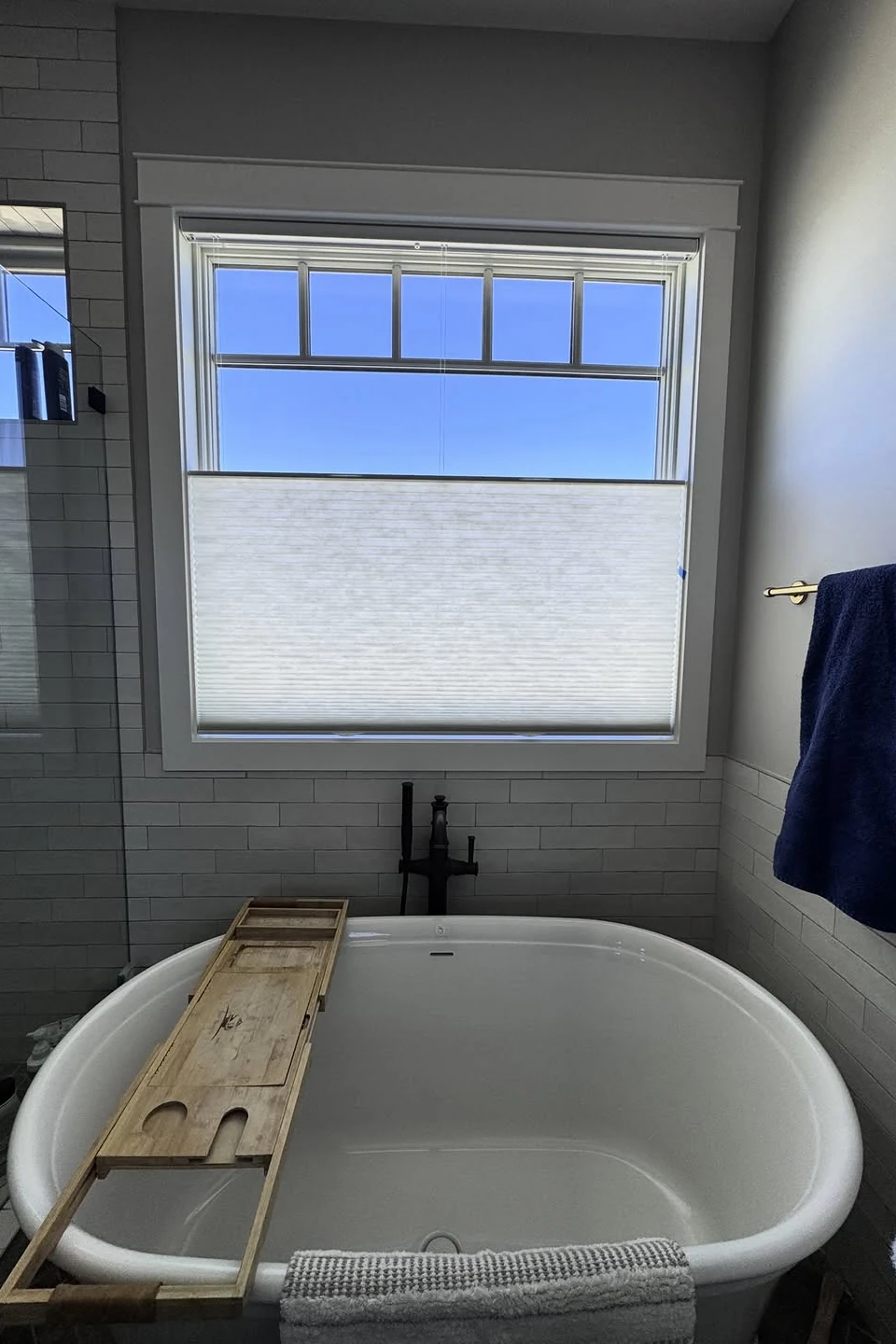
Builders keep putting the tub under the bathroom window, and the window keeps being exactly where a bather does not want an audience. A bottom-up shade answers the geometry precisely. In this bathroom the white cellular shade rises from the sill of a tall window and stops where privacy stops being an issue, leaving the top panes and their blue sky completely open over the freestanding tub.
Cellular fabric earns its place in a wet room twice over. The honeycomb pockets soften the hard echo off tile, and the fabric tolerates steamy air better than timber blinds do. Keep the shade raised a finger’s width off the sill so condensation never pools under it, and drop it fully once a week to dry the bottom rail. Sized right, it is the one treatment in the bathroom you will adjust daily without thinking about it.
- ▸Raise it to seated eye level for a bath, shoulder height for a shower, and drop it flat only when the window needs cleaning.
- ▸Light-filtering fabric, not blackout: the room keeps its daylight and gains a soft glow at the glass.
- ▸Cordless versions are the tidy choice near water, with no loop hanging beside the tub.
Image credit: @blinds_by_brenda_bb — Instagram
14. A Sill Full of Plants: The Screen That Grows
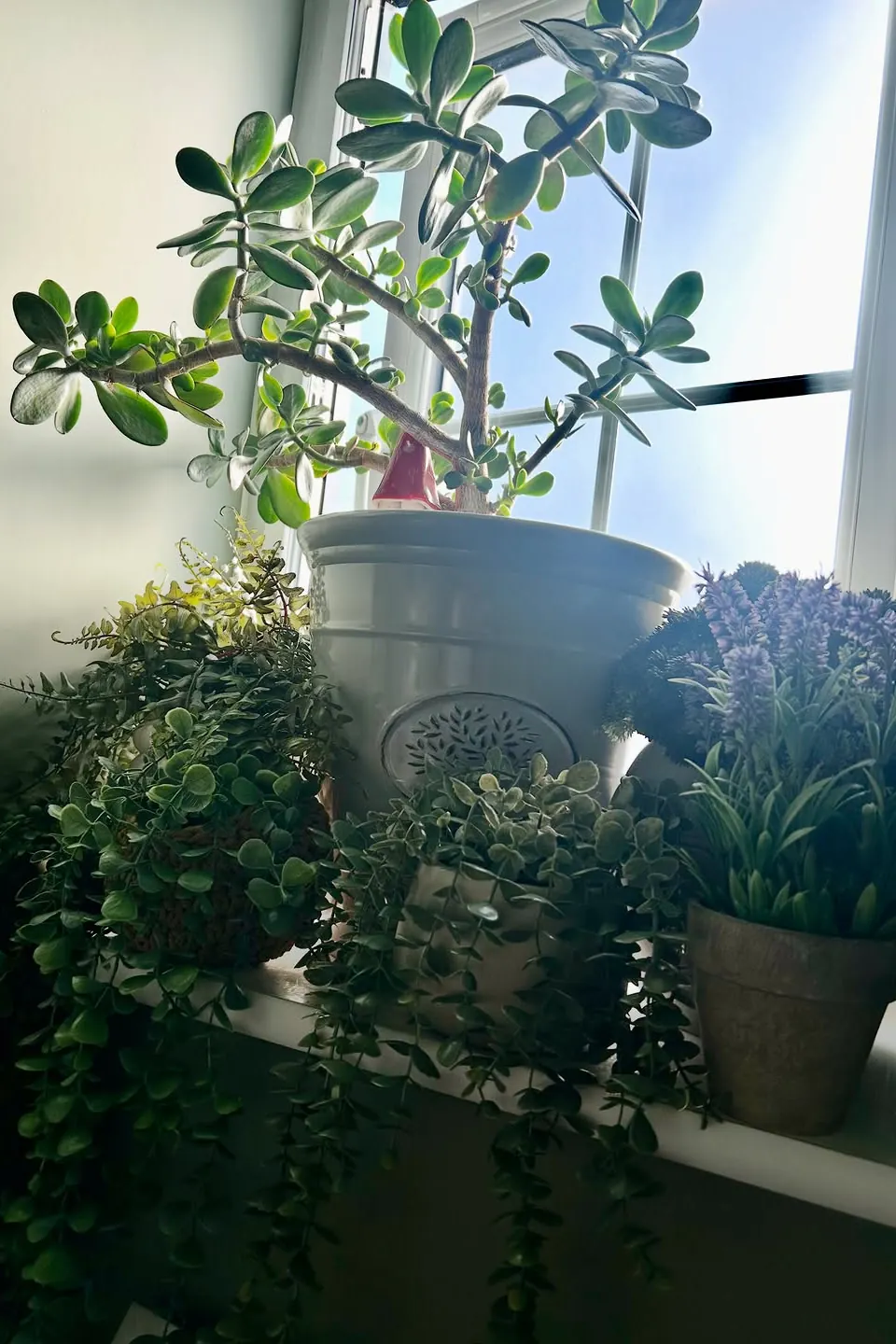
No film, no fabric, no hardware at all: a deep sill crowded with plants screens this window the way a hedge screens a garden. Pots of different heights stack the greenery across the lower glass, trailing stems soften the edges, and the light comes through leaves instead of a bare pane. Anyone outside gets foliage and terracotta. Anyone inside gets the best seat in the flat.
Build the screen in layers: tall plants at the back where the glass is highest, bushy ones in the middle, trailers at the front edge to blur the line of the sill. Herbs suit a kitchen window and earn their space; a bathroom sill wants plants that drink steam happily. The honest cost is upkeep. A plant screen is a living thing with a watering schedule, and a neglected one advertises itself faster than any bare window.
💡 Quick Tip
Put every pot on a tray or saucer before the sill fills up. Condensation rings and watering spills mark paintwork, and a landlord reads a ring on a sill as damage, even when the plants were the best idea in the room.
Image credit: @simpleshelleyinteriors — Instagram
15. A Sheer on a Tension Rod Inside the Frame: The Ten-Minute Answer
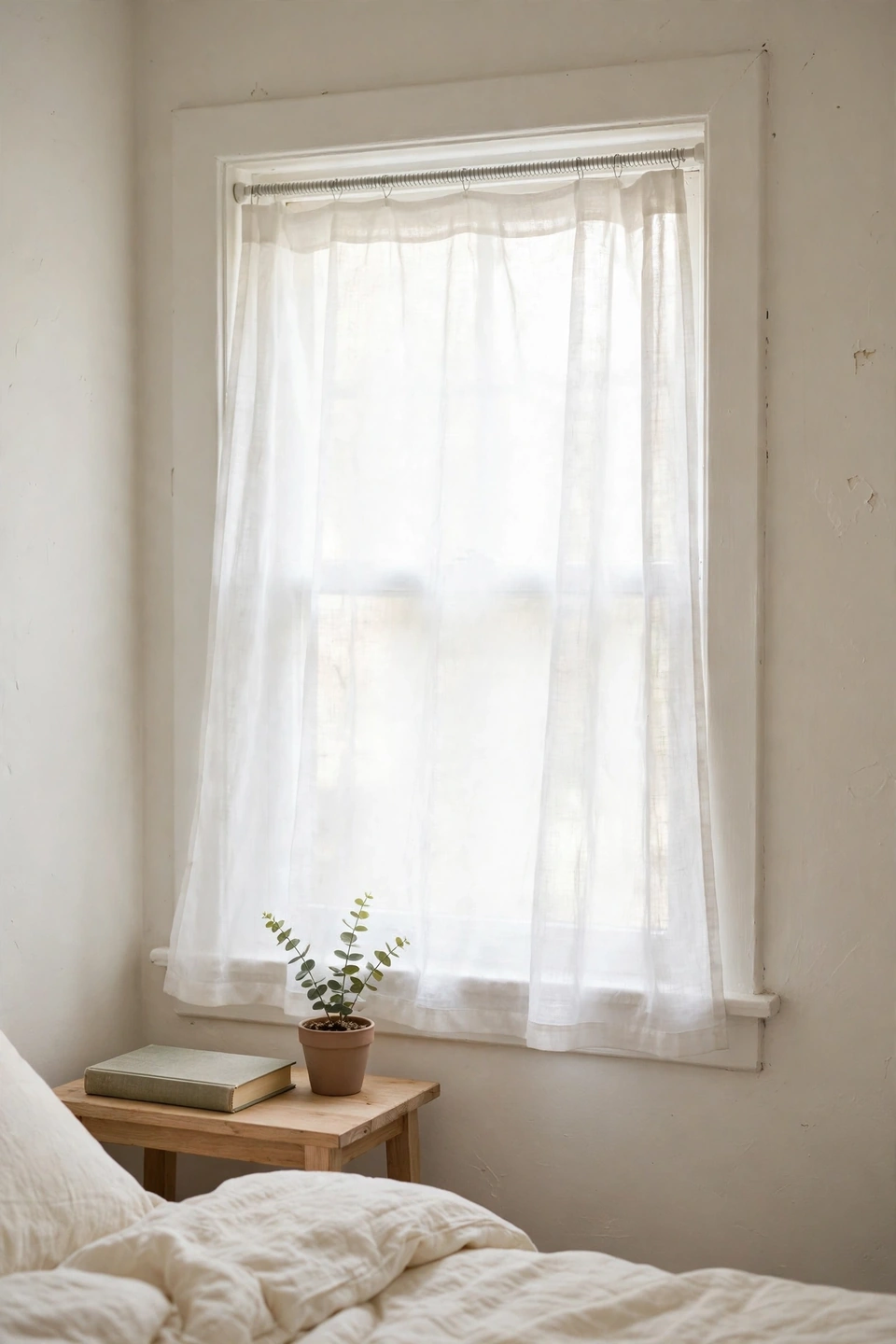
The simplest idea in the list closes it. A white sheer, a spring tension rod twisted longer until it grips the inside of the frame, and a small bedroom window goes from exposed to softly screened in about ten minutes, with the bed made and the kettle not yet boiled. The rod hides inside the reveal, the fabric hangs in gentle folds, and the room’s light turns the volume down without going dark.
This is the treatment to start with if you are new to a flat and unsure what each window needs. It costs little, it moves from window to window as you learn the place, and it comes down in seconds on moving day, leaving the frame exactly as the inventory photo recorded it. Half the renters who start here later upgrade one window to film or a shade, and keep the tension sheers on all the rest.
Privacy is mostly a daytime, eye-level problem. The cheapest tools in this list solve exactly that slice of it, and everything fancier is just the same slice in a nicer material.
Screen the Slice, Keep the Sky
Fifteen ideas, and every one of them rests on the same small discovery: a window does not have to be covered to be private. Film the lower panes, park a shade at the eyeline, hang a sheer inside the frame, or grow the screen on the sill. Window privacy ideas for apartment living work when they respect the light, because the light was the reason for the window in the first place.
Start with the window that bothers you most, and start cheap: a roll of film or a tension rod and a sheer will tell you within a week whether that window wants more. Save this list for the next bare pane you inherit, and pin it for the friend whose bathroom faces the whole street.
For colder months, learn how to winterize apartment windows without damage, and pair your windows with these winter lighting ideas and renter friendly accent wall ideas. The Department of Energy’s guide to energy-efficient window coverings shows which options keep heat in best.
Window Privacy Ideas for Apartments: Questions, Answered
Does privacy window film come off cleanly at move-out?
Static-cling film does. It holds with water and static rather than glue, so it peels away in one sheet and can even be rolled up and reused in the next flat. Adhesive films also come off, but they want heat from a hair dryer and more patience, and they can leave a residue to clean. For a rental, cling is the safer buy every time.
How much light does frosted film actually block?
Less than the fear of it suggests. A standard white frost film passes most of the daylight while scattering it, so a room loses its direct sun patch and its view, but keeps its brightness. Standing in a frosted bathroom at midday, you will not need the light on. Dark tinted films are the ones that genuinely dim a room, and none of the ideas here rely on them.
Will my landlord object to window film? Most never notice it, and a removable film changes nothing about the property. The careful route costs one message: say you are fitting a removable privacy film that peels off without residue, and keep the reply. Anything involving screws, brackets or adhesive pads on walls deserves that message first too, which is why this list leans on tension, static and frames.
What actually gives privacy at night, with the lights on? Density. At night the window reverses: the bright side is yours, and any single sheer or light film shows shapes and movement. A roller blind, a cellular shade, a lined curtain, or film paired with one of those, closes the question properly. That is why ideas 12 and 13 put a real second layer behind the pretty one.
Which is the cheapest route: film, cafe curtains or shades? Film, by a wide margin. One roll covers several windows and needs no hardware at all. A cafe curtain on a tension rod comes next, fabric and rod together for roughly the price of a takeaway for two. Shades cost the most of the three because they are made to a window’s measure, and they earn it back in rooms where you adjust the coverage every day.
Whichever idea you start with, test it from outside before you call it done. Walk to the pavement, the path or the landing, look back at your own window in daylight and again after dark, and adjust the height or the layer until the room you see is light and shapes, not furniture and people.
Free Download
Get the Renter-Safe Decor Checklist
20 landlord-approved products and tricks I use in every small space project, sent straight to your inbox.