
Curtain Ideas for Small Windows: 20 Easy, Beautiful Looks

Small windows get apologized for. They sit over sinks, beside doors and above radiators, too short for standard curtain panels and too narrow for the shop displays, which all seem to assume a wall of glass. So they keep the landlord’s blinds, or a tea towel on a wire, or nothing at all, and the room stays slightly unfinished.
The 20 curtain ideas for small windows below were gathered for exactly those awkward openings. Most are cafe curtains and half-height treatments, the small window’s oldest answer, but the list also covers full-length panels used as a height trick, a tension rod that needs no screws at all, and the renter-safe mounts that matter most: rods inside the frame, clip rings, and fabric light enough for both.
Lengths get honest treatment too. Where a panel should end when a radiator, a desk or a pair of taps lives underneath, why width matters more than price at this scale, and which ideas still work at night, when a sheer stops being private. Start with the three rules, then take the idea that matches your window.
Start Here: Three Rules Every Small Window Obeys
Most small-window failures are proportion failures: panels bought for a standard window, hung at the frame, ending at some random point down the wall. Every idea in this list fixes the proportion first and worries about the fabric second, which is why a two-dollar gingham can beat an expensive panel here.
1. The Classic Cafe Curtain Over the Kitchen Sink
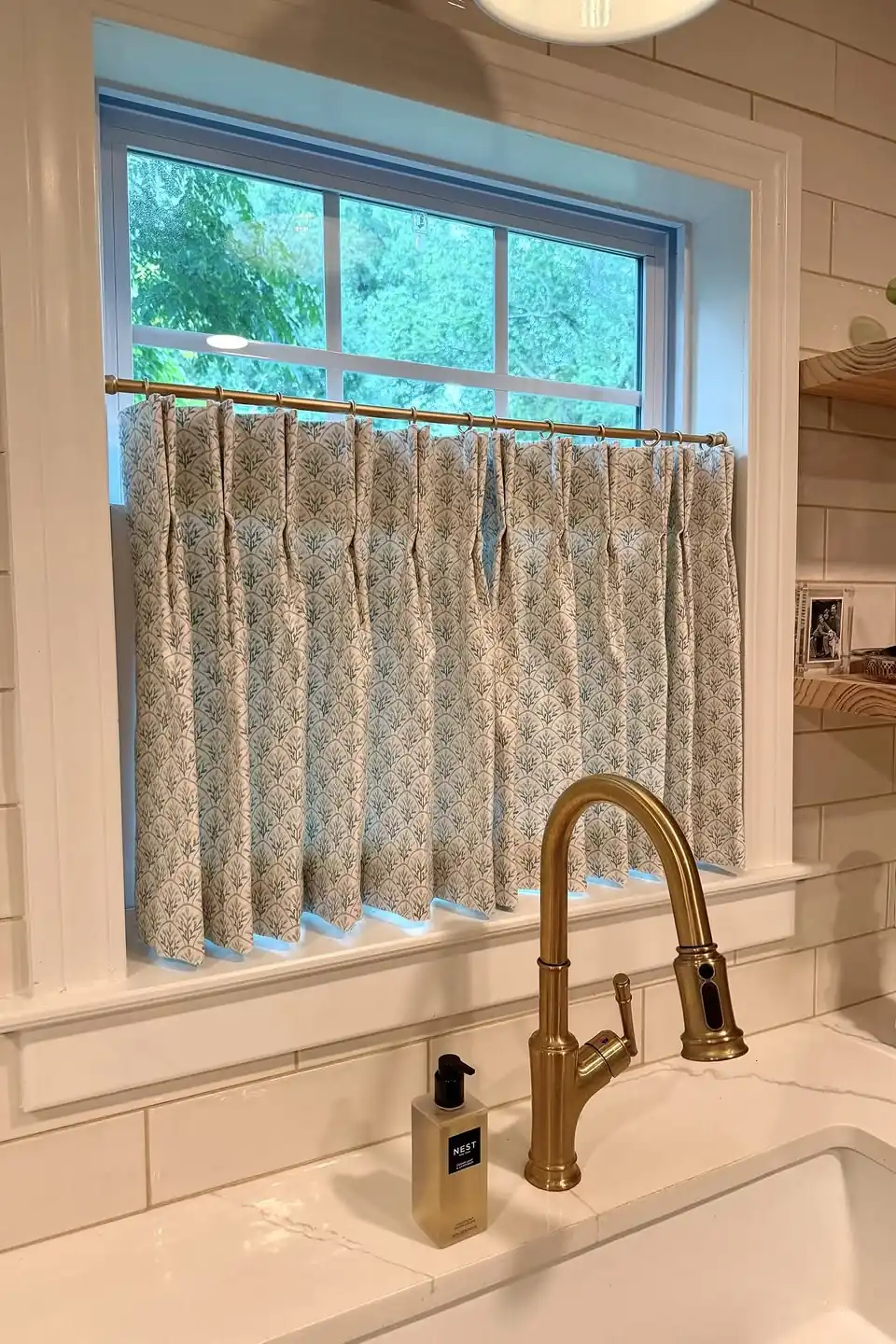
Start with the original. A cafe curtain covers the lower half of the glass and leaves the top open, which is the whole geometry of a kitchen window: the half you need privacy on is the half at standing eye level, and the half that carries the light stays bare. Here a muted floral pair hangs from a slim rod set across the middle of the frame, above a brass faucet and white subway tile.
The print earns its place by being greyed down. Sage and stone flowers on cream read as pattern from the doorway and as texture at the sink, and the rod sits inside the frame lines, so nothing projects over the worktop. Cotton panels this size wash in a normal load, which matters more over a sink than in any other room: they will catch splashes and cooking film, and they should be cheap enough to replace without a wince.
🧩 Renter test: Hold the fabric against the window at midday. If you can read the pattern from the street side, so can everyone else, and a denser weave is the privacy you actually want.
Image credit: @jaimes_drapes — Instagram
2. Natural Linen Cafes for a Wide, Low Window

Wide and low is its own problem: one long panel sags in the middle and two standard panels drown the glass. The answer here is a pair of cafe curtains in unbleached linen, split at the center of a broad farmhouse window and hung from a brass rod at mid-height. The fabric is plainly woven, with the slubs and slight unevenness of real linen left visible.
Texture does the decorating that a print would do on a narrower window. Against marble, white paintwork and brass taps, the oatmeal color is the warmest thing in the room, and because the pair meets in the middle, each half stays short enough to hang straight. A wide window also splits the washing: two small panels, never one heavy curtain.
💡 Quick Tip
Linen shrinks. Wash cafe panels before you hem or hang them, and buy about five percent extra length if you are ordering made-to-measure. A pair that ends a finger’s width above the sill looks deliberate. A pair that ends a finger’s width short of it looks like a mistake.
Image credit: @shop.cushique — Instagram
3. A Tension Rod Inside the Frame: Zero Holes, Zero Tools

The simplest mount in this list needs no bracket, no screw and no permission. A spring tension rod twists longer until its ends press against the inside of the window frame, and the curtain threads straight onto it. This small kitchen window takes a plain white sheer cafe that way, with two pots of herbs on the sill in front of it and the top half of the glass left open.
Tension rods have honest limits. They carry light fabric well and heavy lined panels badly, and they need a frame with enough depth to grip, which most uPVC and timber frames have. In return, the whole treatment comes down in ten seconds for washing or for moving out, and the frame keeps no evidence it was ever there.
Measure the inside of the frame, side to side, at the exact height the rod will sit. Frames are rarely perfectly parallel, so measure twice, top and middle.
Thread the curtain onto the rod first, on a table. Twisting a loaded rod into place is where most tension rods get dropped.
Set one end, compress the spring, seat the other end, then give the rod a quarter turn more. Tug it downward once, firmly. If it holds your tug, it will hold the curtain.
4. Gingham Checks on Clip Rings
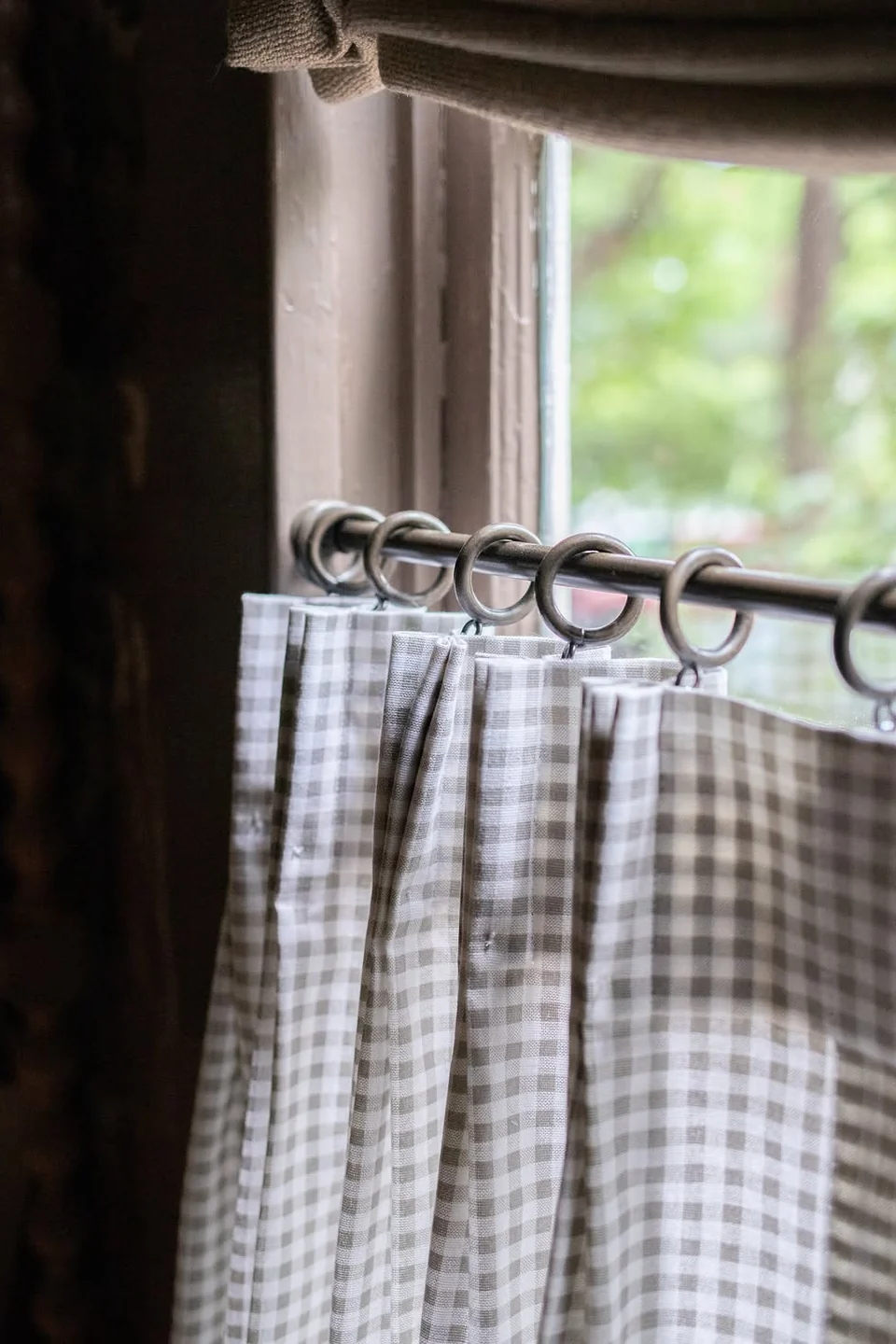
Look at the top of this curtain, because the top is the idea. Grey and white gingham panels hang from large metal clip rings on a dark rod, and the clips do three jobs: they form the soft pleats where they grip, they let the panels glide open with one hand, and they unclip in seconds when the fabric needs a wash, no unthreading a rod pocket.
Clip rings also buy length. A panel that ends above the sill on its own pocket gains the drop of the ring and the clip, which rescues many too-short sale panels. The check is small, in proportion with the window, and the grey keeps gingham out of the farmhouse costume department and into rooms that are otherwise plain.
What you need
Image credit: @loomdecor — Instagram
5. A Printed Sheer That Still Lets the Sunset In

A sheer with a print on it sounds like a contradiction, until the light drops. This white cafe curtain carries black dandelion heads and butterflies, and at sunset the whole panel glows amber while the print stays readable, almost like a screen. During the day it is simply a soft white curtain with a quiet pattern in it.
The honest note belongs to the evening, too. A sheer that glows this prettily from inside is also showing your outline from outside once your lights are on. On a ground-floor window facing the street, treat a printed sheer as a daytime treatment and keep a blind or a denser second layer for after dark. On an upper floor or a garden-facing window, it can be the whole answer.
Image credit: @chikara67 — Instagram
6. The Bathroom Fix: A Short Cafe on a Tall, Thin Window
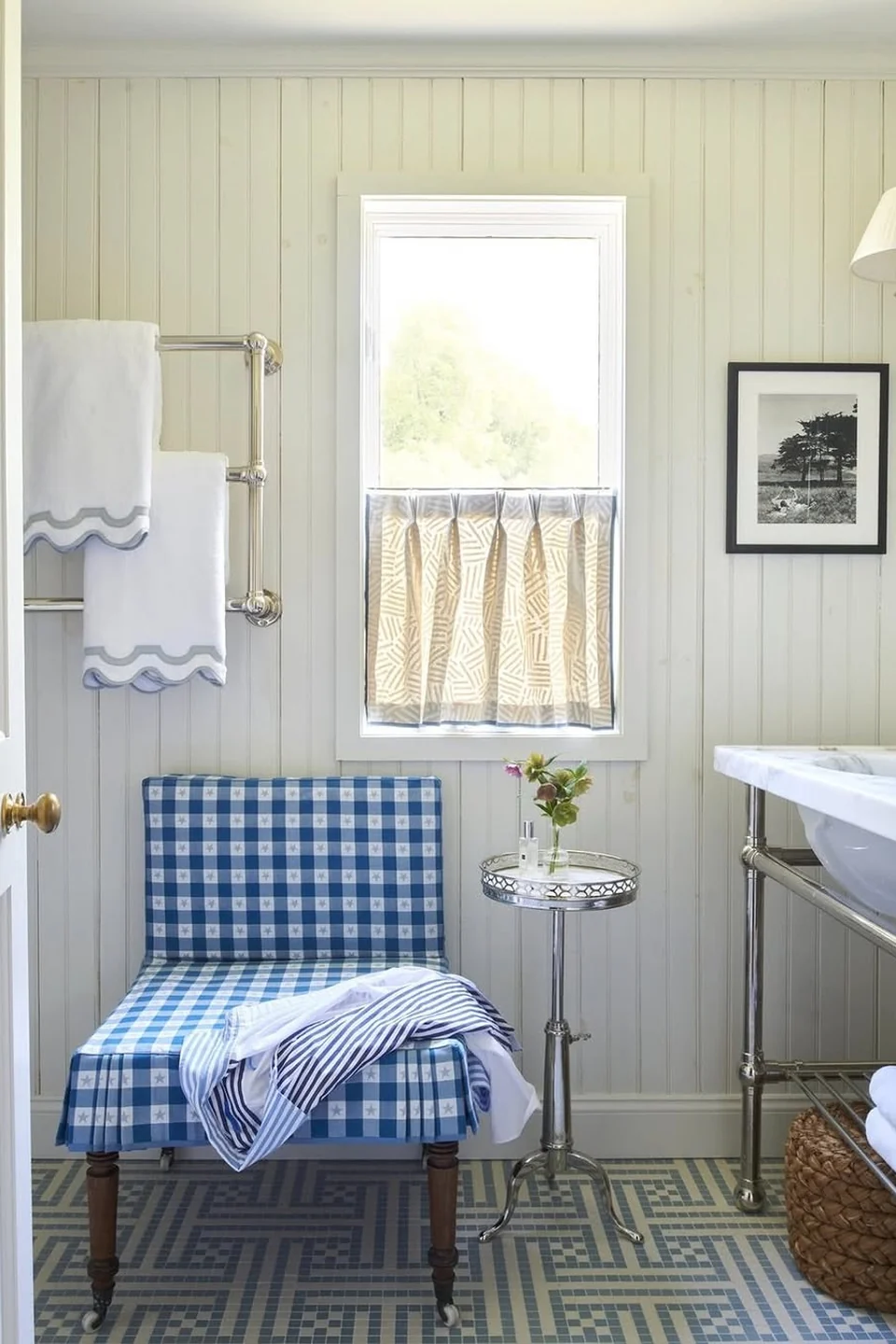
Bathroom windows are often tall and narrow on purpose: high glass for light, low glass nobody should see through. A short cafe curtain across the lower section is the precise answer, and this beadboard bathroom shows the placement well. The little gathered cafe sits where a person stands, the top of the window stays clear, and the room keeps its daylight.
Two bathroom specifics are worth copying. The fabric is short, light and quick to dry, because bathroom air is wet air, and the curtain hangs inside the room’s splash-free zone, away from the shower end. A blue gingham chair and a patterned floor carry the room’s color, so the curtain itself can stay small and pale.
🧩 Renter test: Stand outside at dusk with the bathroom light on, or ask someone to. The cafe should cover the glass up to standing eye level. If it stops at chest height, it is a decoration, not a privacy curtain.
Image credit: @designer_drapery — Instagram
7. Keep the Landlord’s Blinds, Add a Valance on Top

Plenty of rentals come with venetian blinds that work perfectly and look like an office. Removing them invites a deposit argument. Covering their top rail with a short valance does not. This living room keeps its white blinds untouched and hangs a gathered oatmeal linen valance on a slim rod above them, and the window stops reading as rented within one afternoon.
The valance only has one job, hiding the headrail and softening the top edge, so it can stay short: 25 to 35 cm of drop is plenty. Light control stays with the blinds, privacy stays with the blinds, and the fabric brings the warmth. It is the least fabric in this whole list doing a full window’s worth of visual work.
Hang the valance rod on the wall above the frame, where rental walls usually already have marks and fixings are easy to fill.
Let the valance end just below the blind’s headrail, so the mechanism disappears completely.
Taking the blinds down and storing them. A lost or bent blind is a classic deposit deduction.
A deep, swagged valance. On a small window it eats the glass and dates the room.
8. The Two-Tier Set: Valance Above, Tie-Ups Below

A matched set does the thinking for you. This cottage kitchen window wears a taupe tie-top valance with white embroidery across the top, a deep white ruffle under it, and sheer panels below that tie up with fabric bows. Three pieces, one fabric family, and the window can be dressed up or down through the day by tying the panels higher or lower.
Sets like this suit small windows because every piece is already in proportion; nothing needs cutting down. The colors do quiet work too. Taupe, cream and white let the embroidery and the ruffle exist without shouting, and the fresh flowers and teapot on the sill sit happily in front of it. It is the most dressed window in this list, and it still leaves the top glass open.
The three pieces, in order
Image credit: @curtaincatalog — Instagram
9. A Small Botanical Print, Scaled for a Small Window

Print scale is where small windows punish bad shopping. A big cabbage rose on a 60 cm window shows you two flowers and a lot of seams. This cream cafe curtain uses a small botanical sprig, green and brown stems repeated closely, and the whole repeat fits the window many times over, so the pattern reads as pattern rather than as fragments.
The colors help as much as the scale. Leaf green and bark brown on cream sit quietly against white tiles and a marble counter, and the curtain stops above the worktop where it belongs. If you shop one rule from this pillar, make it this one: hold the fabric at arm’s length, and if one motif is bigger than your open hand, it is too big for a small window.
📌 Good To Know
Small prints forgive crooked hanging. A tiny repeat hides a slightly uneven hem and seams that do not match perfectly, which makes it the safest first curtain to sew or hem yourself. Save large, exact-match patterns for windows with room to show them.
Image credit: @shopdraperie — Instagram
10. Pulled Open to the Sides: Cafes That Frame the View

Not every cafe curtain wants to stay closed. This small kitchen window over a sink wears a plain white pair drawn open to both sides, so the glass works at full size all day and the fabric becomes a frame, with a simple wall clock filling the space above the window. At night the same panels slide shut on their rod and the window is covered.
It is the most ordinary photo in this article, and in some ways the most useful. No print, no color, no special hardware: a short rod, two white cotton panels with enough width to bunch softly at the sides, and a window that looks tended instead of bare. Folded towels on the counter and jars on the sill do the rest.
| Panels drawn open | Panels closed |
|---|---|
| Full daylight and the whole view, best for daytime hours at the sink. | Privacy for the evening, and the room feels softer with the glass covered. |
| The bunched fabric frames the window and makes a plain frame look finished. | Needs fabric at one and a half times the width, or the closed curtain stretches thin and shows gaps. |
Image credit: @giosmama2626 — Instagram
11. Hang It High and Wide and the Window Grows
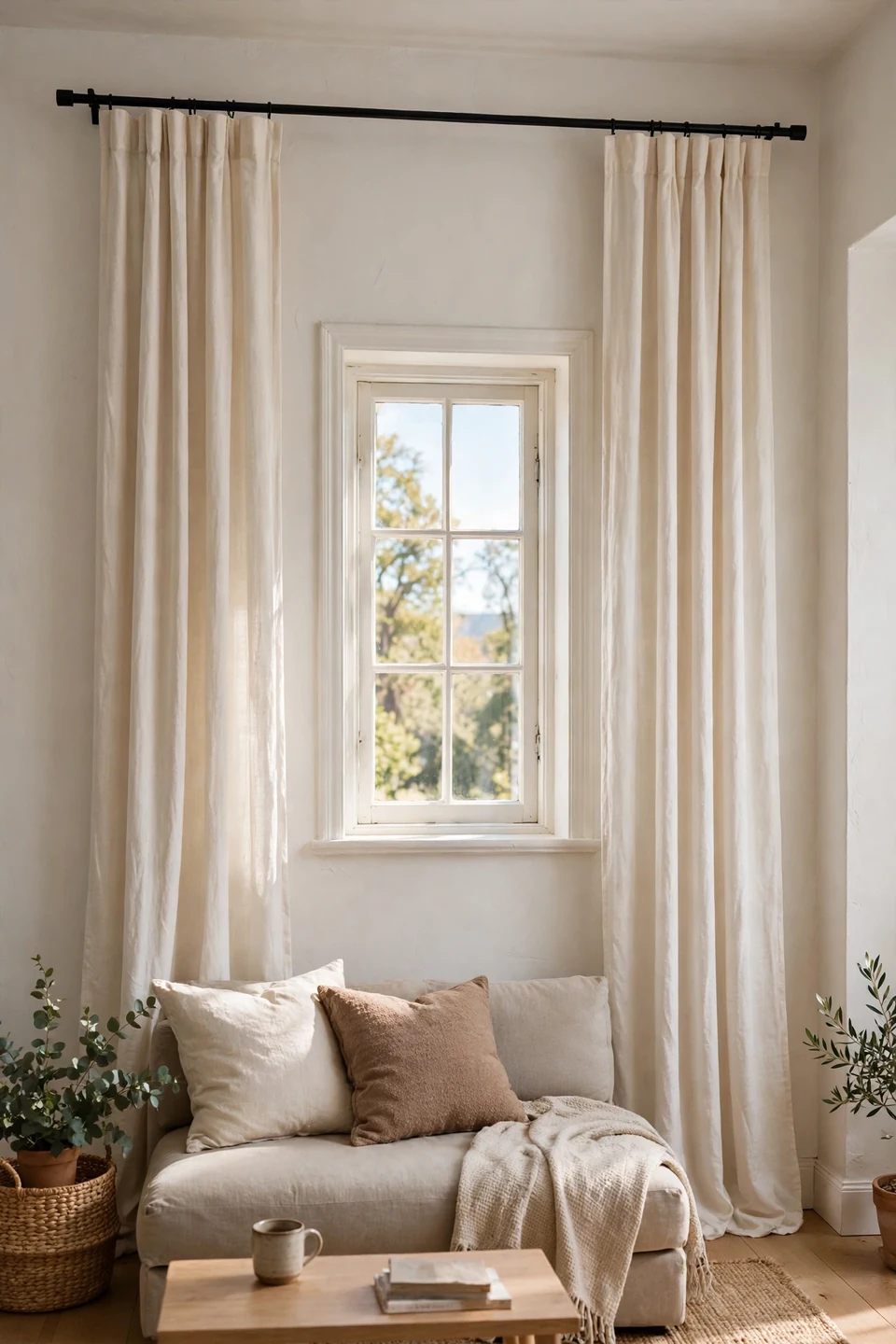
The oldest trick in this list, and still the most reliable. The rod goes up near the ceiling line and out past both sides of the frame, and long cream panels fall from that height to the floor. The window in the middle is genuinely small. It just no longer looks it, because your eye reads the whole arrangement, rod to floor and edge to edge, as the window’s size.
Two details make it work in a rental living room. The panels stack back onto the wall, not the glass, so no daylight is lost, and the small window keeps its full opening. The fixings sit on the wall high above the frame, the least visible spot in the room, and two small filled holes at move-out are a fair trade for years of a taller-looking room.
Mount the rod 10 to 15 cm below the ceiling, or just under the coving, not just above the frame. Height is the whole point.
Run the rod 15 to 25 cm past the frame on each side, so the open panels rest on wall and the glass stays fully clear.
Hem the panels to just touch the floor. A puddle looks romantic in a showroom and dusty in a small rental by March.
12. Floor-Length Panels on a Short Window

A close cousin of the high-and-wide trick, with a different emphasis: the panels themselves run the full height of the wall, so the fabric becomes two long vertical lines that the eye follows down to the floor. In this Manhattan dining room the cream and rust leaf print falls from above the frame to the boards, and the evening light from a small lamp does the rest.
Note what the panels do not do. They do not cover the glass or the radiator beneath it; they flank both, which keeps the heat working and the window usable. A vertical print helps, since the leaves repeat downward and stretch the drop further. At night, drawn together, the pair turns a plain rental window wall into the warm end of the room.
A short window with a short curtain, ending mid-wall, which underlines exactly how little glass there is.
Panels from above the frame to the floor. The wall reads as one tall opening, and the window borrows height from the fabric.
Image credit: @rosiethompsonhome — Instagram
13. Bedroom Sheers at Half Height

Bedrooms ask for two things that fight each other: privacy in the morning and light to wake up to. Sheer cafe curtains on the lower half split the difference. This bedroom runs them across two tall black-framed windows, so the bed sits behind a soft white screen while the top glass pours in daylight and a view of the trees.
The sheers here are plain, gathered on rods inside the frames, and slightly translucent rather than transparent: faces and shapes blur, light does not. In a dim room the effect reads calm rather than clinical, helped by grey bedding and nothing patterned anywhere near the windows. It is idea 5’s sheer, chosen denser and used where privacy matters more.
💡 Quick Tip
Set the top of a bedroom cafe above standing eye level as seen from outside, not from inside. On a ground floor that usually means the rod sits at about two thirds of the window’s height. Check it from the pavement at dusk before you call the job done.
Image credit: @aura.home.life — Instagram
14. One Strong Color: Orange Cafes in a White Kitchen

Every other curtain in this list whispers. This one does not. Two orange sheer cafes hang over a white farmhouse sink, and the color is the entire decorating scheme: the sunlight comes through the fabric tinted warm, the brass faucet picks it up, and a room of plain white cabinets gets its one decision made.
Sheer is what makes a strong color safe on a small window. The same orange in a heavy cotton would block light and shout; as a sheer it glows and stays light on its feet. Keep everything around it plain, as here: white tiles, wood, a plant or two. One loud thing, small area, thin fabric. The formula travels: deep green, brick red or mustard all behave the same way.
Image credit: @lovemyfabricla — Instagram
15. A Single Panel, Swept to One Side
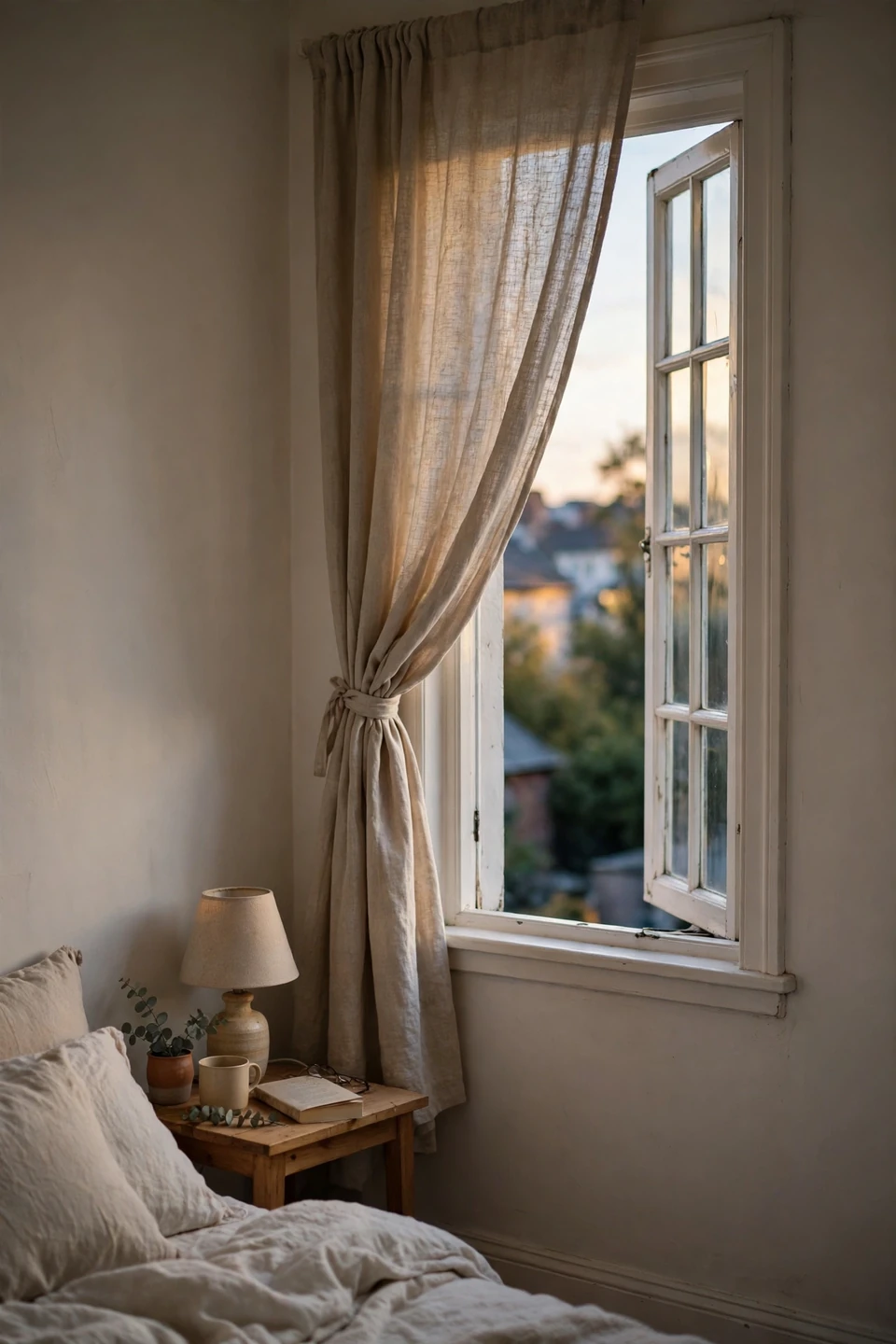
Pairs are a habit, not a rule. A narrow window beside a bed or tucked near a corner often has wall on one side and furniture on the other, and a single linen panel swept to the open side suits it better than two panels fighting for space. Here the panel gathers into one soft column held by a tieback, and most of the glass stays open to the evening light.
The asymmetry is the charm: the window looks dressed, not blocked. One panel also halves the fabric cost and the washing. Let the panel down at night and it covers the narrow window completely, since a single panel at double width closes over a small opening without strain.
When one panel beats a pair
16. Pinch Pleats on Clip Rings, for a Tailored Middle Band
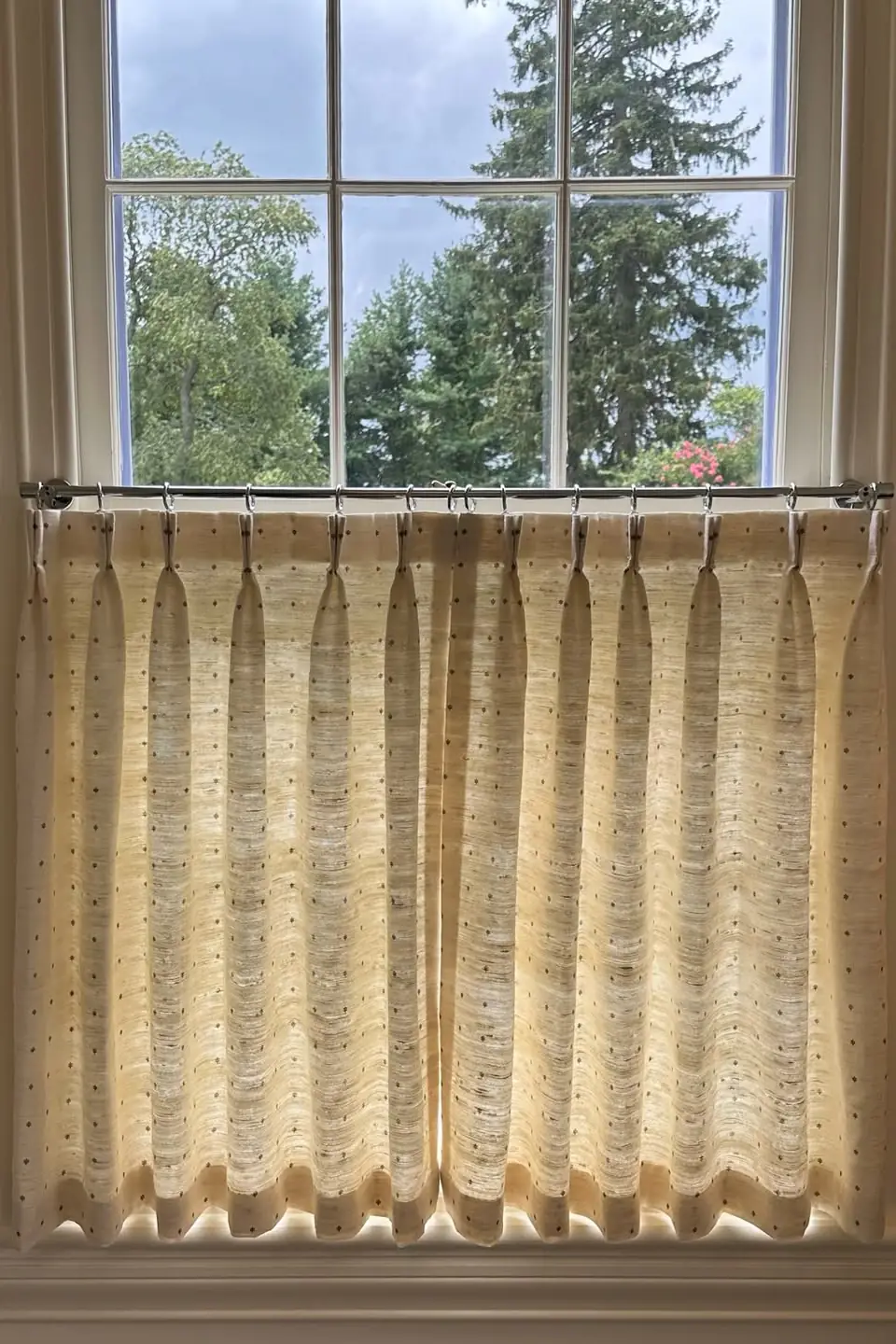
Cafe curtains have a reputation for being casual, and pinch pleats are how you argue with it. This cream panel carries neat pinch pleats across its top and hangs from clip rings on a rod set across the middle of a tall six-pane window, so the treatment reads tailored, closer to a dining room than a farm kitchen. The fabric is a dotted weave, plain at a distance and detailed up close.
Pleats are not free. Each pinch eats fabric, so a pleated panel needs roughly double the window’s width to fall in those even folds instead of stretching flat. Clip rings keep the rental side of the bargain: the pleats are pinched into the panel itself, the rings just carry it, and the whole thing unclips and comes down without touching the rod’s fixings.
🧩 Renter test: Clip the panel up and step back to the doorway. The folds should look identical from pleat to pleat. Even folds mean the width is right; a flat stretch in the middle means it is not.
Image credit: @mainlinewindowdecor — Instagram
17. The Same Cafe, Three Windows in a Row

Kitchens with a run of windows over the counter raise a dull but real question: same curtain three times, or three different ones? This green kitchen answers firmly. Identical geometric print cafes on matching brass rods, at the same height on all three windows, and the repetition turns three separate openings into one long, deliberate feature above the sink run.
The measuring trick is to work from the ceiling down, not from each frame up. Window frames in older kitchens are rarely level with each other, and rods set the same distance below the ceiling read as level even when the frames are not. Buy all the fabric in one order, too: dye lots shift, and the third window is exactly where a slightly different green would show.
Match the rods as well as the fabric, and set every rod the same distance below the ceiling.
Order all panels in one go, so the color matches across the whole run.
A different treatment on the middle window to break it up. On a short run it just looks like a mistake.
Measuring each rod from its own frame. Unlevel frames will tilt your whole line.
Image credit: @shopmadeintheshade — Instagram
18. Sill-Length Panels Where a Radiator Lives

Some windows come with furniture built in underneath: a radiator, a desk, a storage bench. Long curtains over a radiator pour heat into the fabric instead of the room, and panels behind a desk get trapped, creased and dusty. The tidy answer is a panel cut to end exactly at the sill, shown here in sage green over a desk-and-radiator nook with a laptop below.
Sill length has a reputation for looking abrupt, and the fix is precision. Ending the hem level with the sill reads as a decision. Ending it two centimeters above or below reads as a shortage. Measure after the rod is up, in three places across the width, and hem to the lowest measurement so the line stays straight.
| Length | Best under the window |
|---|---|
| Sill length: hem level with the sill. | A radiator, a desk, a bench, or anything the fabric would rest on. |
| Apron length: 10 to 15 cm below the sill. | A plain wall with nothing under it, where a little overlap looks softer. |
| Floor length: hem touching the floorboards. | Nothing under the window at all, and height is what the room needs most. |
19. A Slim Black Rod Across the Middle of a Wide Window
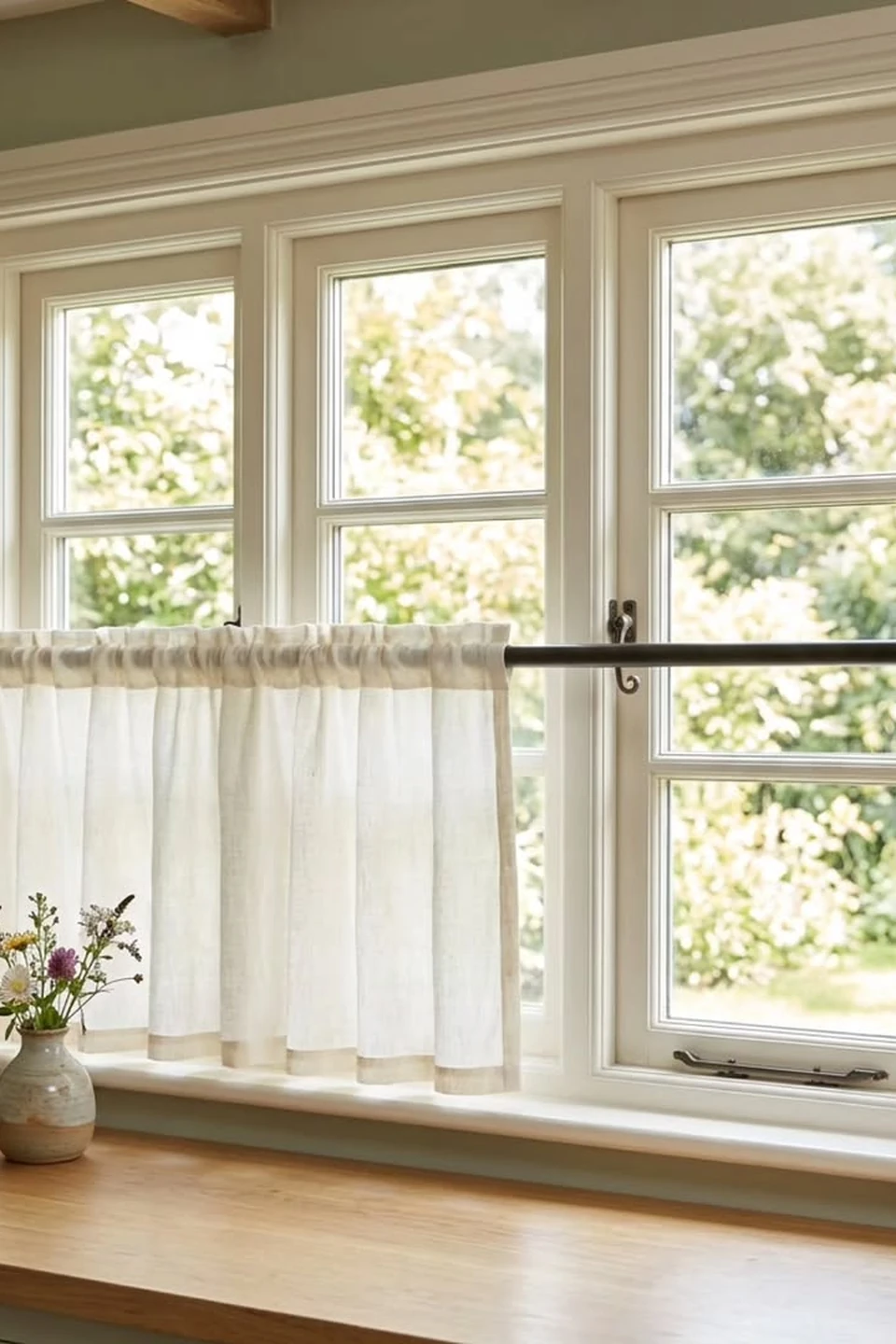
Hardware is usually chosen to disappear. Here it does the opposite. A slim black rod runs straight across the middle of a wide white-framed window, carrying a gathered cream sheer below it, and the dark line becomes a deliberate part of the design: it matches nothing in the room except the window’s own geometry, and it works like the underline in a sentence.
The rod sits at the window’s natural horizontal break, where the frame’s middle rail runs, which is why the placement looks settled rather than random. Below it, a wooden counter with a small vase gets privacy at seated height. Above it, the top panes stay open. Wide spans are the one caution: a long thin rod can bow in the middle, so span wide windows with a center support or two rods meeting at the center post.
⚠️ Watch Out
A rod much past a meter and a half wants a middle bracket, or it will sag a little more every month. On a wide rental window, use two shorter rods butted together at the center mullion instead: the mullion hides the join, and each span stays straight.
Image credit: @mhpolesandtracks.co.uk — Instagram
20. The Bay Window: One Sheer Treatment, Every Pane
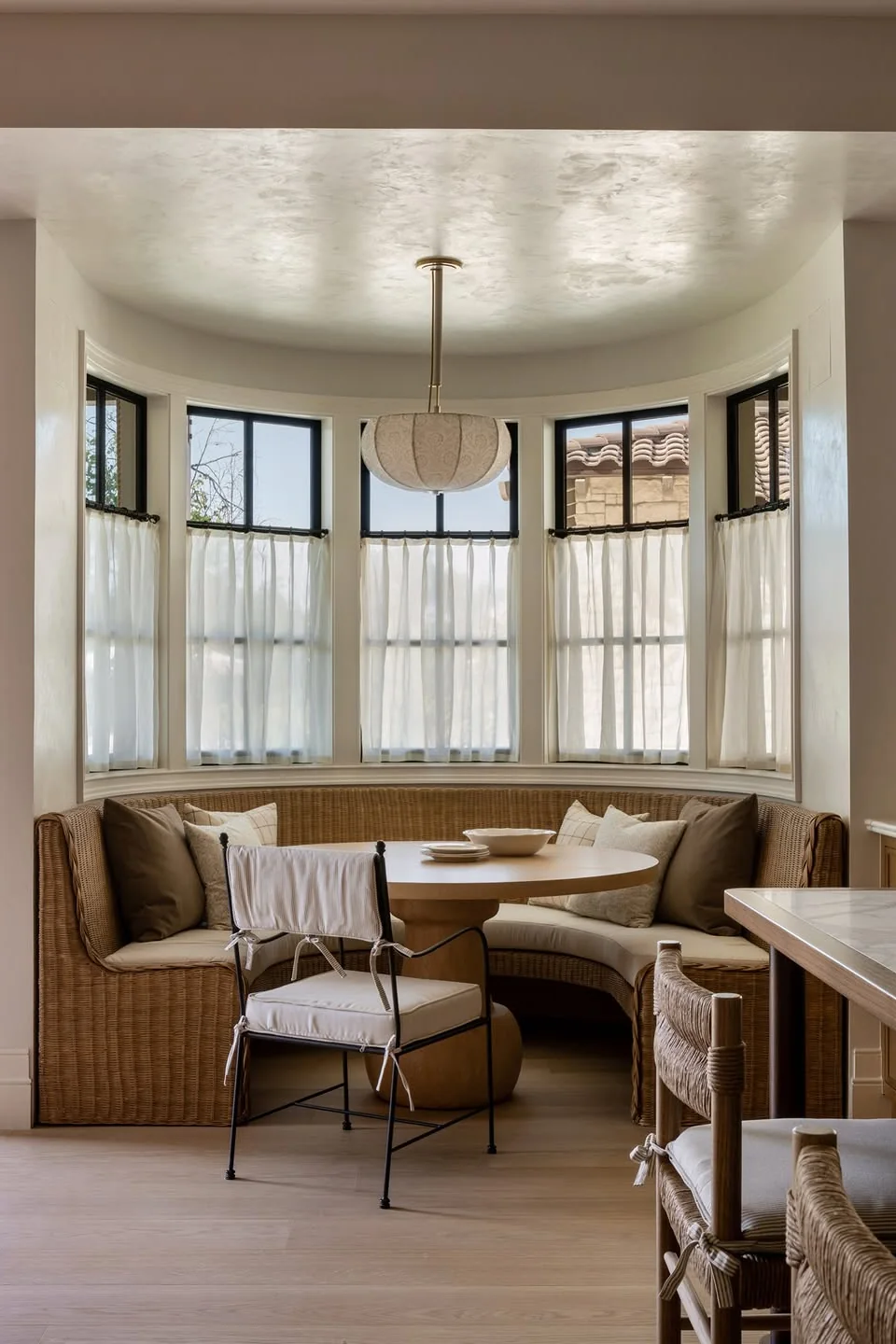
A bay window is really several small windows in a row, and it rewards the same discipline as idea 17, carried around a curve. In this dining nook every pane of the curved bay wears the same sheer white cafe at the same height, so the banquette below sits inside one soft, bright enclosure, with the upper glass and the treetops left open.
Seat-level privacy is the point of a nook: you are sitting still, in daylight, close to the glass. The sheers blur the street while the table keeps its sun. Individual short rods inside each frame, or a flexible bay rod, both work; what matters is the unbroken line of the hem as it steps around the curve, measured from the floor, not from each sill.
Repetition reads as design. One plain treatment, kept at one exact height across every pane, makes a row of small windows feel like one generous one.
Image credit: @lindyegalloway — Instagram
Small Windows, Same Rules as Big Ones
Nothing in this list is a compromise for a lesser window. Cafe curtains guard the half of the glass that matters, full-length panels borrow height a short window does not have, and a tension rod or a set of clip rings hangs either without leaving a mark. Curtain ideas for small windows succeed on proportion and placement, not on price: the right length, the right width, and a mount a renter can defend.
For colder months, learn how to winterize apartment windows without damage, and pair your windows with these winter lighting ideas and renter friendly accent wall ideas. The Department of Energy’s guide to energy-efficient window coverings shows which options keep heat in best.
Save the list for the next bare window you inherit. Measure it honestly, pick the one idea that matches what sits under it, and let a small piece of fabric make the smallest window in the flat look like it was always meant to be there.
Small Window Curtain Questions, Answered
How wide should curtains be for a small window?
One and a half to two times the window’s width, total. Below one and a half, a cafe curtain stretches flat and looks mean; at double width the folds stay soft even when the curtain is closed. For pinch pleats, allow the full double width, because every pleat consumes fabric.
What length works best on a short window?
It depends on what lives underneath. Sill length above a radiator or desk, apron length (10 to 15 cm below the sill) over a plain wall, and floor length when the goal is height and nothing blocks the drop. The one length to avoid is an accidental one, ending mid-wall with no reason.
How do I hang curtains without drilling?
A tension rod inside the frame is the cleanest answer for cafe curtains and sheers, and it carries light fabric reliably. Clip rings on any existing rod make panels easy to move and wash. For a valance above blinds, two adhesive hooks rated for the rod’s weight can work on smooth walls, but keep the fabric light and test one hook overnight first.
Do cafe curtains look old-fashioned?
The shape is old; the fabric decides the date. Linen, cotton gingham, dotted weaves and plain sheers read current, especially on slim rods with clip rings. Shiny synthetic frills are what carry the dated reputation. Keep the fabric matte and the heading simple and the style follows.
How much privacy does a sheer cafe curtain give at night?
Less than in the day. With your lights on and darkness outside, a sheer shows silhouettes and movement. For a street-level bedroom or bathroom, pair it with a blind or choose a denser cafe weave for the evening hours, the way ideas 6 and 13 suggest. Daytime privacy, which is when most small windows need it, stays excellent.
Whichever idea you start with, take the before photo from the doorway. A month later, with the window dressed and the light coming through fabric instead of bare glass, the comparison will tell you which window to do next.
Free Download
Get the Renter-Safe Decor Checklist
20 landlord-approved products and tricks I use in every small space project, sent straight to your inbox.